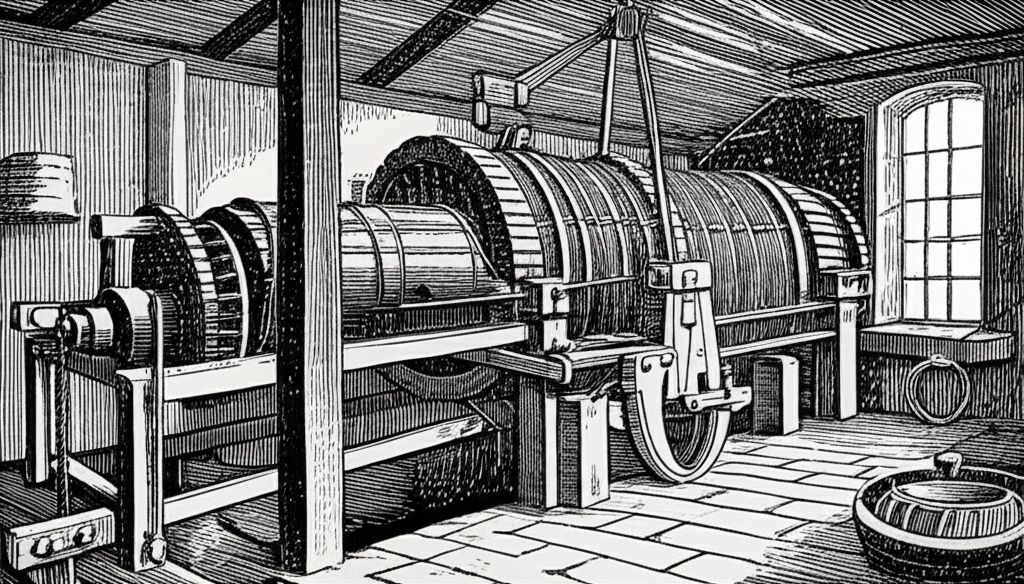
Sir Richard Arkwright’s invention, the Water Frame, patented in 1769, represented a pivotal moment in textile manufacturing. While James Hargreaves’s spinning jenny had increased the quantity of yarn produced, its output was often fragile and suitable only for the weft. Arkwright’s machine, by contrast, utilized a series of rollers rotating at different speeds to draw out and twist the cotton fibers, resulting in a significantly stronger and more uniform thread. This robust yarn was ideal for the longitudinal warp threads of cloth, a critical bottleneck that had previously limited production.
The true strategic brilliance of the Water Frame lay not just in its output, but in its operational requirements. Its immense size and reliance on a continuous power source—water—made it entirely unsuitable for the domestic cottage industry. This necessity catalyzed a fundamental reorganization of labor and capital. Arkwright effectively pioneered the factory system by constructing large, purpose-built mills, most famously at Cromford. Here, workers were brought together under one roof, their labor synchronized with the unceasing rhythm of the machinery. This centralization allowed for unprecedented levels of supervision, quality control, and production efficiency, establishing a blueprint for industrial organization that would define the era.