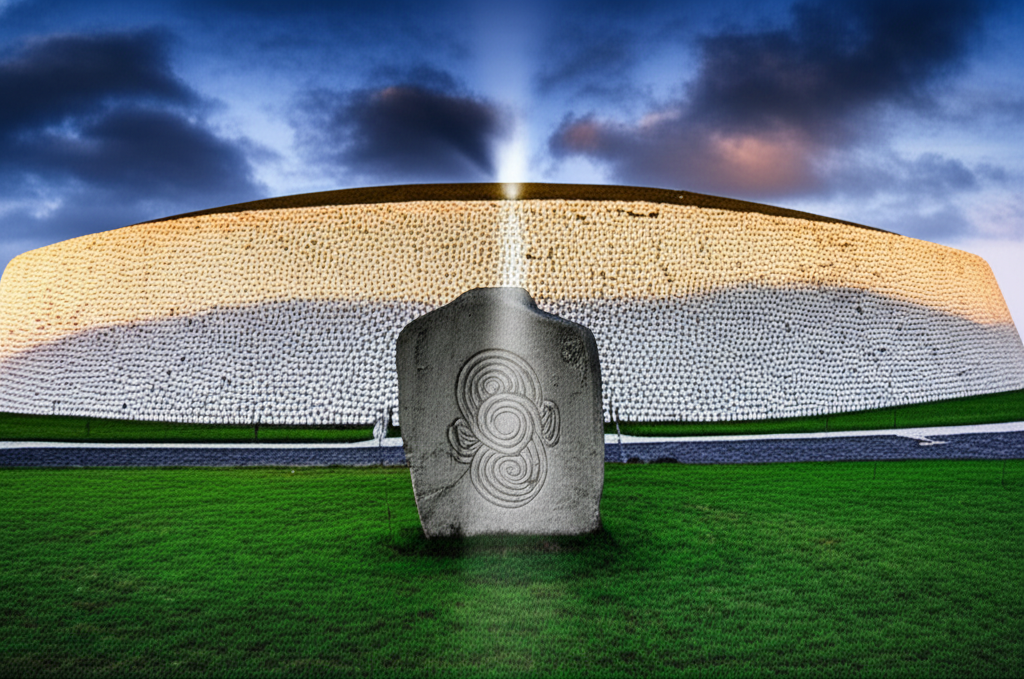
The erection of the passage tomb at Newgrange represented a zenith in Neolithic engineering, constructed approximately five millennia ago within the Boyne Valley. The builders executed a sophisticated logistical strategy, utilizing the nearby river to transport massive greywacke kerbstones from quarries situated nearly twenty kilometers away. The mound’s structural stability relied upon alternating layers of soil and stone, reinforced by a striking façade of white quartz that functioned as a visual beacon within the ancient landscape.
Internal integrity was secured through the implementation of a dry-stone corbelled roof. This architectural optimization distributed the immense weight of the capping cairn outward, ensuring the inner sanctum remained impervious to water infiltration for thousands of years. Such durability indicates that the architects prioritized permanence, consciously designing the monument to survive well beyond the lifespan of the labor force that constructed it.
The orientation of the passage reveals the builders’ advanced command of observational astronomy. Above the main entrance, they integrated a specialized roof-box, a distinct aperture designed with mathematical exactitude. This feature functioned as a precise mechanism to capture the Winter Solstice sunrise.
As the sun ascended on the shortest day of the year, a beam of light penetrated this opening, traversing the nineteen-meter passage to illuminate the chamber floor. This calculated alignment confirms that the structure served a dual purpose: it was a repository for the dead and a monumental calendar marking the regeneration of the solar cycle, anchoring the society to the rhythm of the seasons.