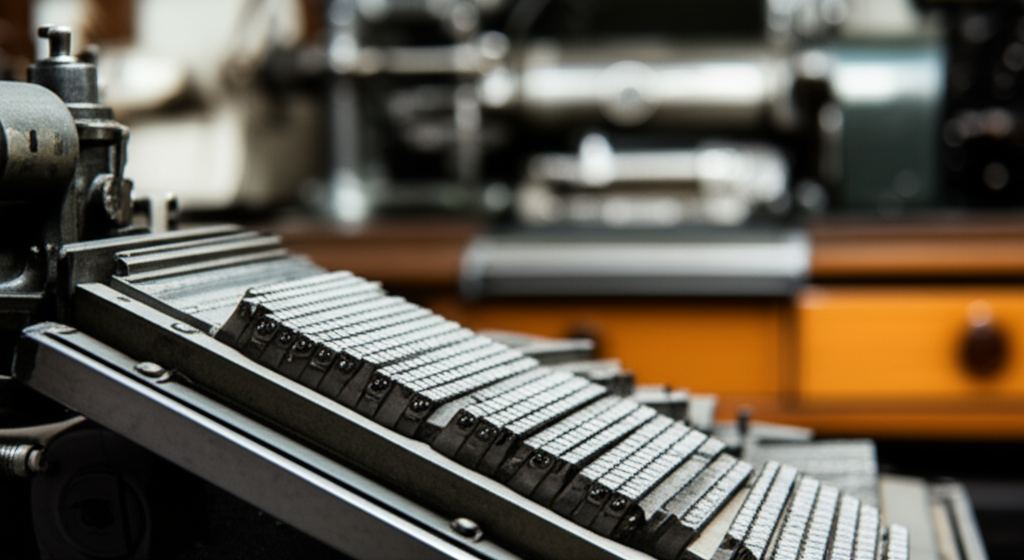
In the late nineteenth century, the landscape of hot metal typesetting underwent a profound transformation. While earlier mechanization efforts prioritized the rapid casting of entire lines of text, the introduction of the Monotype system by Tolbert Lanston in 1887 offered a fundamentally different strategic approach. Rather than producing solid blocks of text, the system cast individual characters. This methodological pivot granted printers unprecedented control over the final typographic output, effectively bridging the gap between mechanized production speed and the refined aesthetic quality of traditional hand composition.
The true optimization of the system lay in its divided operational design. To maximize efficiency, the compositional process was separated into two distinct mechanical units:
The keyboard, which an operator used to punch a coded paper ribbon.
The caster, an automated machine that read the perforated ribbon to pour molten lead into specific matrices.
This division of labor allowed compositors to draft text continuously without waiting for the heavy mechanical casting cycle to finish. Furthermore, if an error occurred during proofing, printers needed only to extract and replace a single defective letter rather than recast an entire line. This modularity proved invaluable for complex projects, particularly in scientific, mathematical, and tabular printing, where spatial precision was paramount. By refining the mechanical tolerances of lead casting, the system did not merely automate printing; it fundamentally elevated the structural integrity and typographic flexibility of the printed word throughout the twentieth century.