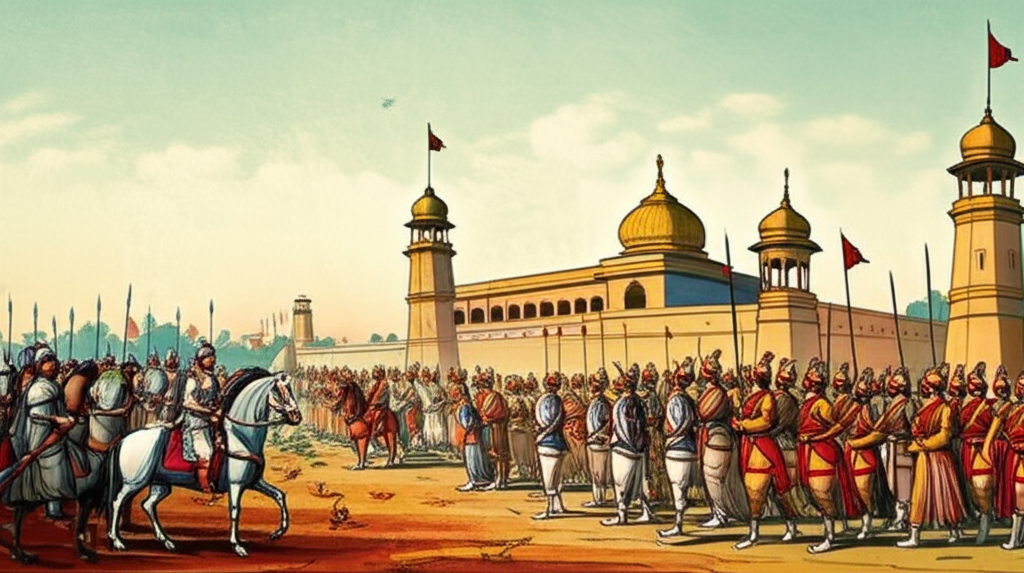
The rise of the Maratha Empire represented a significant shift in the political landscape of the Indian subcontinent, driven by innovative military strategies and sophisticated administrative systems. The initial foundation laid by Shivaji Maharaj was predicated on the masterful use of ganimi kava, or guerrilla warfare. This approach, which capitalized on the rugged terrain of the Western Ghats, allowed his smaller, highly mobile forces to consistently outmaneuver the larger, more conventional armies of the Mughal Empire and the Deccan Sultanates. The strategic placement of hill forts served as secure bases for launching rapid raids and retreating safely, neutralizing the numerical superiority of his adversaries.
Following this foundational period, the empire’s expansion under the Peshwas marked a transition from regional defense to imperial ambition. The Maratha state’s military campaigns were financed through a systematic policy of revenue collection from subordinate territories. This system was primarily based on the imposition of chauth, a levy amounting to one-fourth of the revenue, and sardeshmukhi, an additional ten percent tax. These levies were not arbitrary plunder but a calculated method of asserting sovereignty and funding a continuously mobilized army.
This expansion was managed through the Maratha Confederacy, a decentralized structure where powerful chiefs such as the Scindias and Holkars governed their own domains while owing allegiance to the Peshwa. This system facilitated simultaneous military operations across vast distances, enabling the Marathas to project power from their homeland in Maharashtra to the far reaches of northern and eastern India, establishing them as the dominant power prior to the consolidation of British rule.