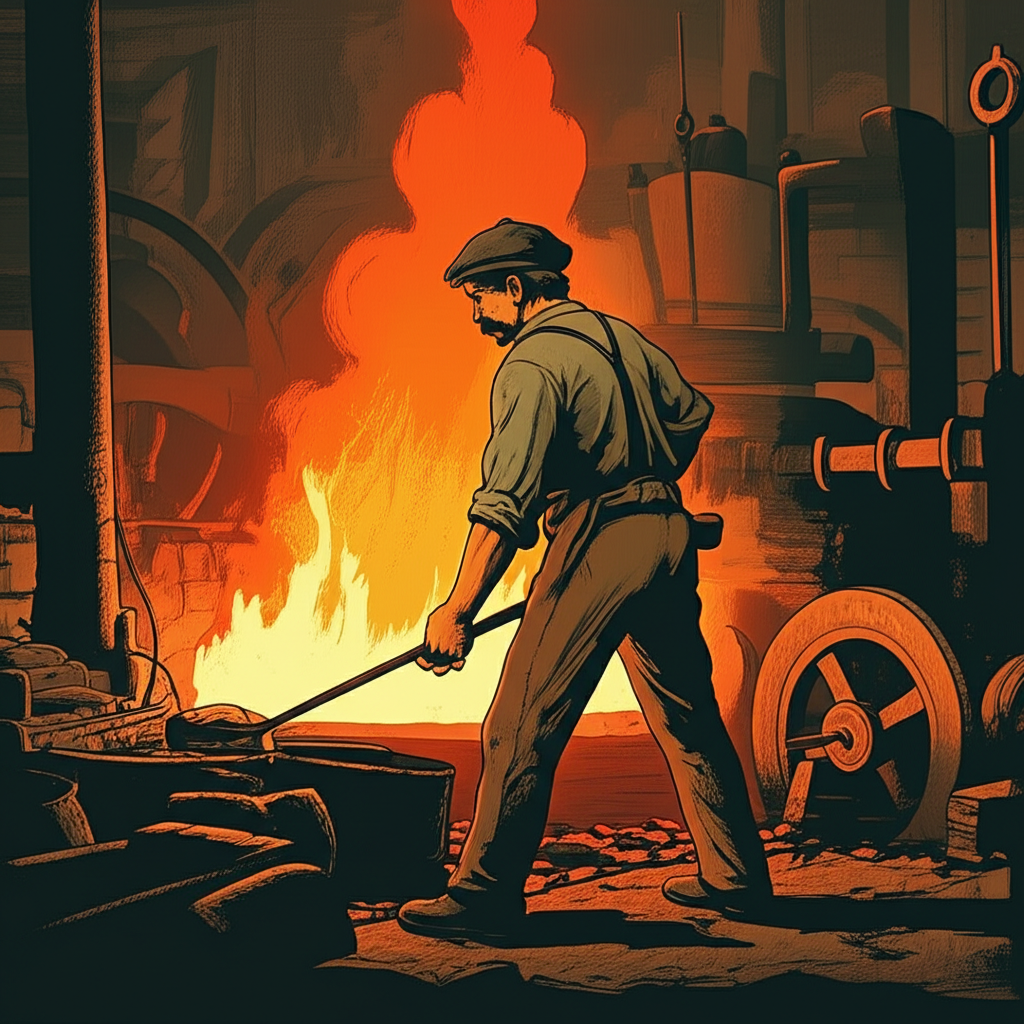
Within the hierarchy of the Victorian ironworks, the Puddler occupied a singular station of prestige and peril. Far removed from the unskilled laborer, this artisan possessed an intuitive mastery over the chemical transformation of brittle Pig Iron into malleable Wrought Iron. The work demanded not merely brute strength but a refined judgment of heat and viscosity, executed within the searing confines of the Reverberatory Furnace.
The operational strategy of the puddler was one of endurance and precision. Utilizing long iron rabbles, the worker agitated the molten bath to expose it to oxygen, a critical method for decarburizing the metal. This process reached its apex during the phenomenon known as “coming to nature,” where the iron began to solidify into pasty lumps. Here, the puddler’s optimization of movement was paramount; he had to gather the congealing metal into “blooms” while maintaining a temperature sufficient to expel impurities without burning the iron. A failure in timing resulted in waste, diminishing the yield and the artisan’s piece-rate earnings.
Yet, this technical expertise exacted a severe physiological toll. Puddlers stood exposed to radiant heat often exceeding 3,000 degrees Fahrenheit, resulting in a condition frequently cited in medical records of the era as “puddler’s blindness”—cataracts caused by the intense glare of the fire. Their working life was notoriously brief, with few retaining the physical capacity to manage the furnace beyond their thirties. Ultimately, the puddler stood as a complex figure of industrial efficiency: a master of the forge whose very expertise accelerated his physical decline.