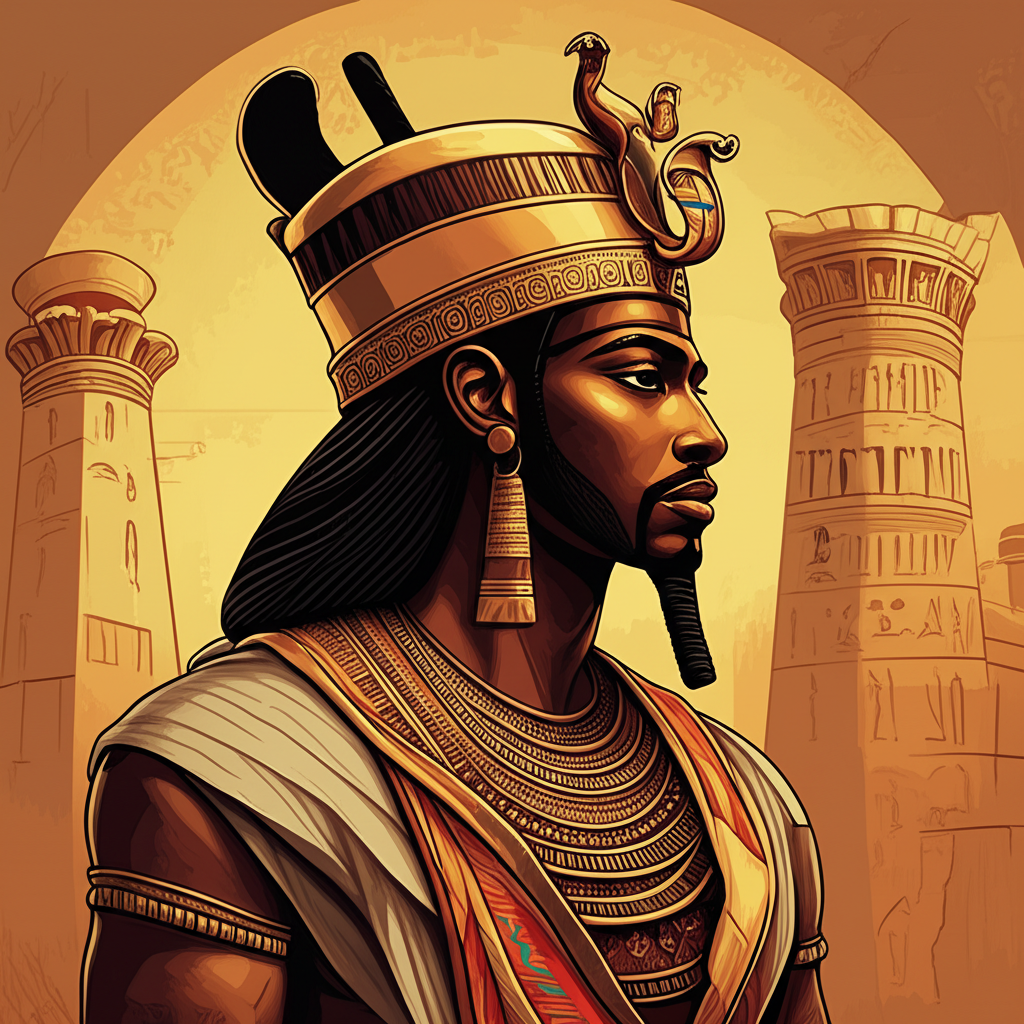
During the chaotic fragmentation of the Third Intermediate Period, the political vacuum in Lower Egypt presented a strategic opportunity for the rising power of Kush. Operating from their capital at Napata, the Kushite rulers did not view themselves as foreign invaders, but rather as the true custodians of ancient traditions. The annexation of the north was methodically executed under the leadership of Piye, whose military campaign was characterized by a unique synthesis of religious zeal and tactical superiority.
Piye’s advance down the Nile was framed not merely as territorial expansion, but as a restoration of order against the Libyan chieftains who had fractured the Delta. By leveraging his intense devotion to Amun, the priesthood in Thebes readily accepted Kushite authority, granting Piye a critical diplomatic foothold without prolonged bloodshed. The siege of Memphis proved the decisive engagement, where Kushite naval prowess and siegecraft overwhelmed the northern coalition. Following this victory, vassal rulers submitted, solidifying the establishment of the 25th Dynasty.
Once in power, the Kushite pharaohs, particularly Shabaka and Taharqa, pursued a policy of cultural and architectural renaissance to consolidate their rule. Their governance strategy relied on distinct optimization efforts:
The revival of pyramid construction, a practice absent in Egypt for centuries, to signal dynastic continuity.
Massive restoration projects at Karnak and other sacred sites to legitimize their divine right to rule.
* The maintenance of existing administrative structures to ensure economic stability across the unified territories.
This era represented a monumental unification of the Nile Valley, stretching from the Mediterranean to the Blue Nile. The Kushite sovereignty successfully revitalized Egyptian art and theology, merging Nubian vitality with Pharaonic orthodoxy until the eventual pressure of Assyrian incursions destabilized the region.