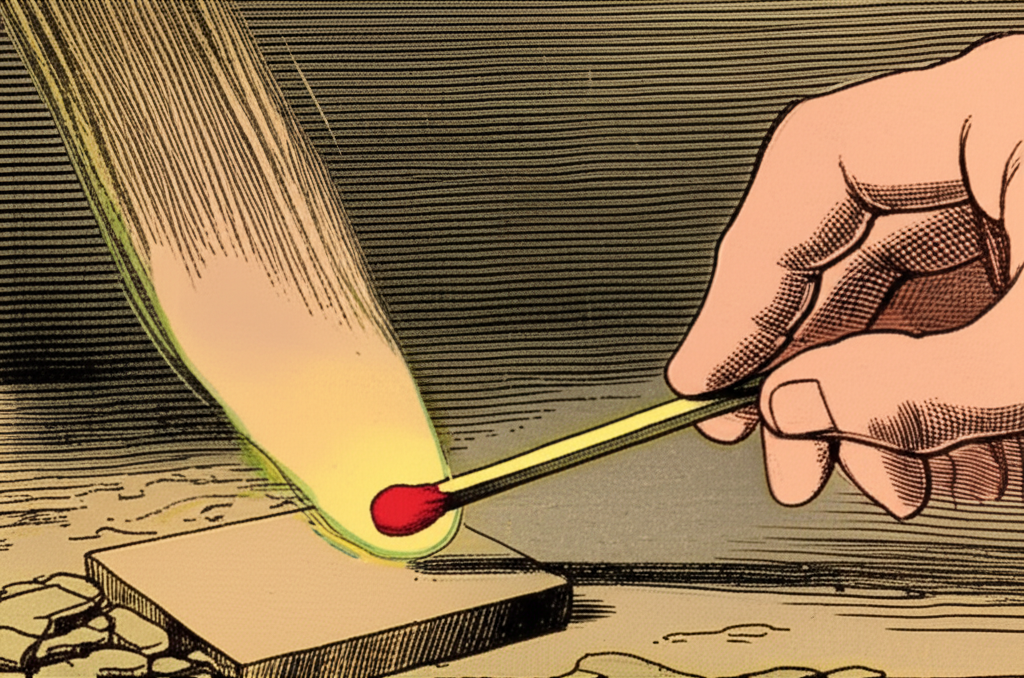
In the annals of chemical engineering, the year 1826 marked a definitive shift in the generation of fire. John Walker, a chemist operating in Stockton-on-Tees, inadvertently revolutionized combustion technology while seeking a more efficient method for lighting explosives. While scraping a mixing stick coated in a specific chemical paste, Walker observed that the friction caused the substance to ignite. This discovery rendered the cumbersome flint and steel, as well as the dangerous chemical dips of the era, effectively obsolete.
Walker’s formulation was not merely accidental but the result of precise chemical understanding. He utilized a volatile mixture of antimony sulfide and potassium chlorate, bound together with gum and starch to adhere to wooden splints. This composition allowed for a rapid, exothermic reaction when struck against a prepared rough surface, typically sandpaper. These early devices, which he distributed under the name Friction Lights, represented a significant optimization in daily utility, offering immediate flame through kinetic energy rather than complex mechanical apparatus.
Despite the evident commercial potential of his discovery, Walker declined to secure a patent. His decision, rooted in a philosophical desire to advance scientific knowledge for the public good, allowed competitors to capitalize on the innovation. Most notably, Samuel Jones of London analyzed Walker’s unprotected methods and launched the Lucifer, a direct derivative of the original Friction Light. Walker’s legacy remains that of a pioneer whose scientific acumen provided the blueprint for modern ignition, even as he eschewed the commercial dominance that typically accompanies such a monumental invention.