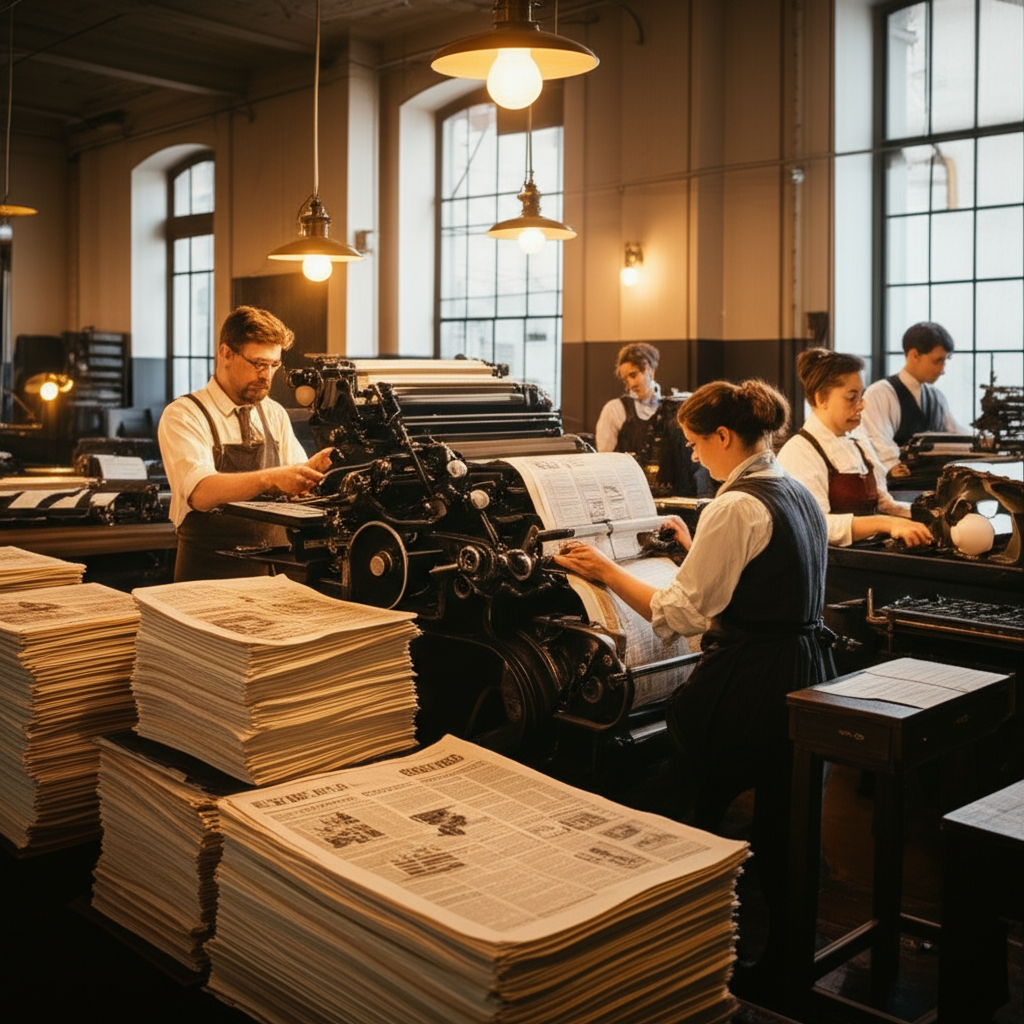
Before the late 19th century, the dissemination of daily news was stifled by the arduous limitations of manual labor. The compositor’s hand, picking individual characters from a type case, established a rigid ceiling on production volume. This constraint was shattered in 1884 with the introduction of Ottmar Mergenthaler’s revolutionary invention, the Linotype machine. By mechanizing the typesetting process, Mergenthaler fundamentally altered the economics of publishing, shifting the industry from a craft-based model to industrial mass production.
The device allowed an operator to cast an entire line of text, known as a slug, from molten lead using a keyboard interface. This innovation replaced the slow manipulation of loose type with hot metal typesetting, increasing composition speeds by a factor of six. Consequently, the cost of printing plummeted, allowing proprietors to increase page counts without incurring prohibitive expenses. What was once a four-page morning brief evolved rapidly into a substantial daily volume filled with lucrative advertising, serialized features, and late-breaking reports.
The efficiency of the Linotype catalyzed the proliferation of the penny press and the modern newspaper era. Publishers could now issue multiple editions per day, reacting to global events with unprecedented immediacy. This technological leap did not merely optimize a workflow; it fueled an era of fierce circulation wars and cemented the printed word as the primary vehicle for mass communication throughout the industrial age.