In the mid-nineteenth century, the dissemination of written information faced a critical mechanical bottleneck. While the public demand for daily periodicals surged, the existing print technology remained tethered to the inherent limitations of the flatbed press. These machines relied upon a slow, reciprocating motion that restricted output speed. It was within this climate of industrial necessity that Richard March Hoe conceptualized a radical departure from established lithographic traditions, fundamentally altering the trajectory of mass communication.
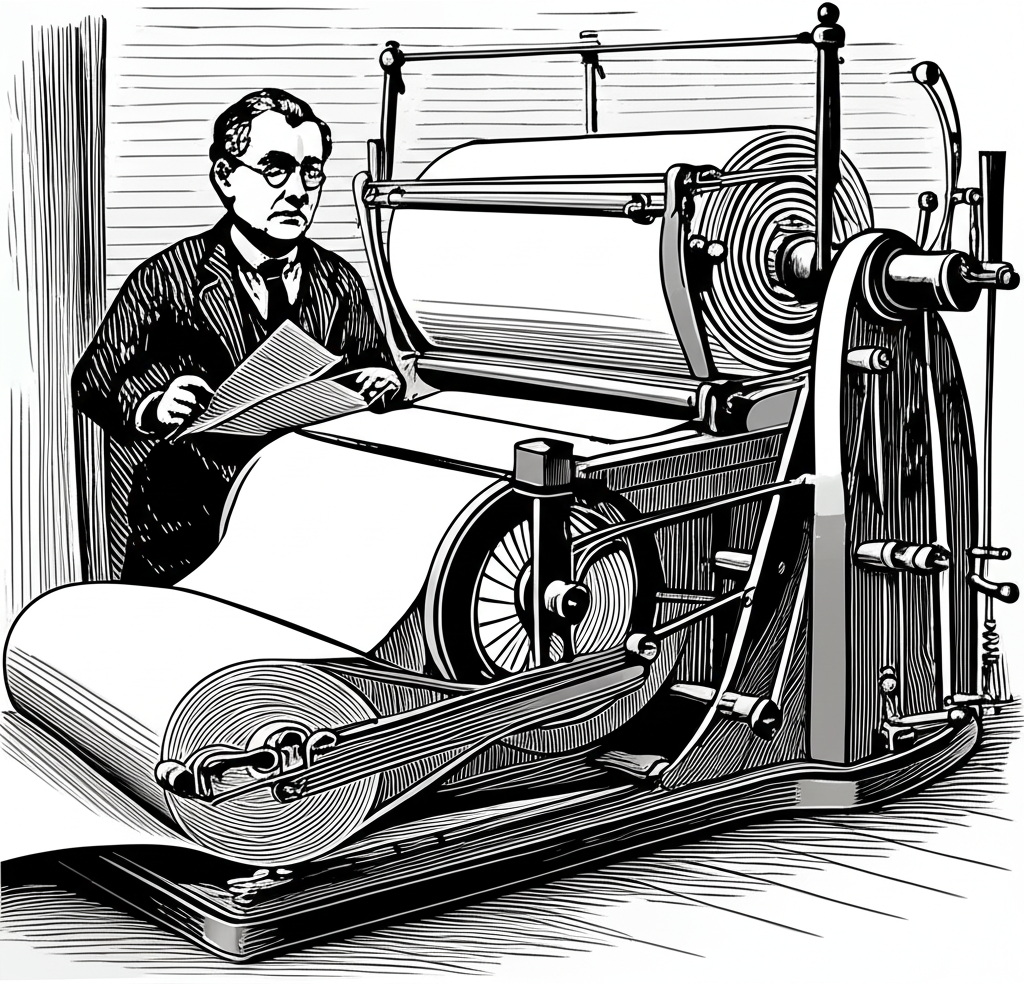
Hoe’s strategic insight lay in the realization that production velocity could only be maximized by eliminating the inertia of the back-and-forth carriage. Consequently, he directed his engineering prowess toward the principle of continuous revolution. In 1843, he developed a mechanism that placed the type forms not on a static flat bed, but upon a central, rotating cylinder. This innovation, technically designated as the Type Revolving Press, allowed for a continuous interaction between ink and paper, bypassing the distinct pause required by previous iterations for impression.
The culmination of this development was the commercial release of the “Lightning Press” in 1847. By surrounding the central type cylinder with multiple smaller Impression Cylinders, Hoe enabled several operators to feed sheets simultaneously. This architectural optimization exponentially increased output, allowing a single machine to produce up to 8,000 copies per hour. The transition from reciprocating flatbeds to rotary motion did not merely improve efficiency; it unlocked the physical capacity for mass-market journalism, securing Hoe’s legacy as the architect of modern high-speed printing.