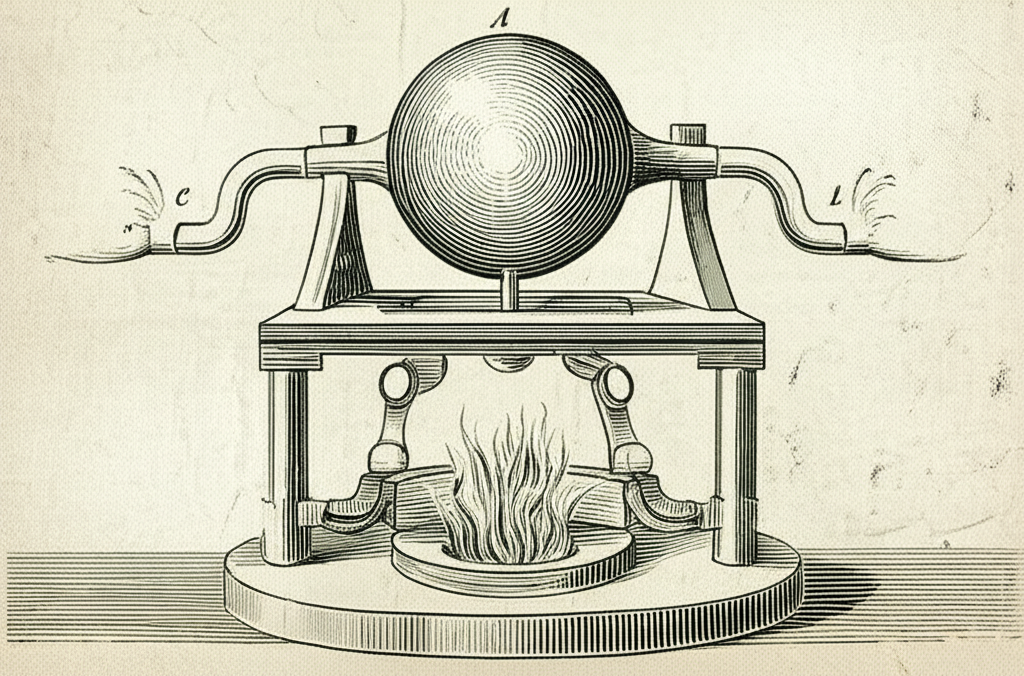
In the annals of mechanical history, the Aeolipile of Hero of Alexandria stands as a singular curiosity. Conceived in the 1st century CE, this device is often cited as the first rudimentary steam engine. However, interpreting it through the lens of industrial application is anachronistic. The primary objective of its construction was almost certainly not to produce mechanical work in a practical sense, but rather to serve as a powerful demonstration of scientific principles.
The Aeolipile was a sophisticated scientific instrument, designed to illustrate that the invisible force of heated water vapor could be converted into tangible motion. It functioned as a brilliant confirmation of theoretical knowledge concerning pneumatics and the properties of gases, subjects of great interest to Hellenistic engineers. It was a device intended to provoke wonder and educate a learned audience, not to power a workshop.
The failure of the Aeolipile to catalyze an industrial revolution was not a shortcoming of its design but a reflection of its socioeconomic context. The Roman world possessed a vast supply of manual labor, which created little incentive for the development of labor-saving machinery. Without a pressing economic need or a manufacturing framework to support its evolution, Hero’s invention was destined to remain a philosophical and pedagogical tool rather than a prime mover of industry. It represented a principle understood long before its application became necessary.