
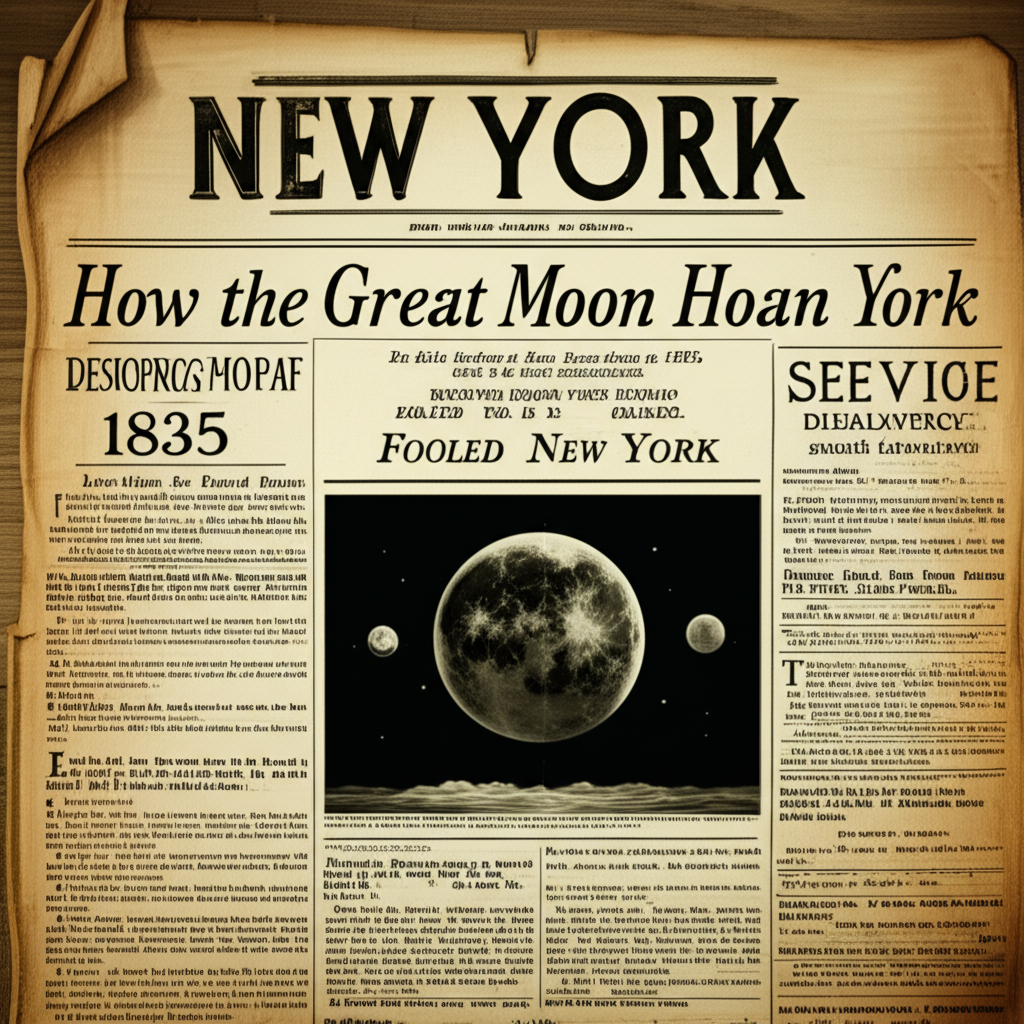
In the late summer of 1835, the burgeoning landscape of New York journalism was irrevocably altered by a calculated fabrication known as the Great Moon Hoax. Published by The Sun, a penny press newspaper seeking to dominate a crowded market, the series of six articles captivated a populace eager for scientific advancement. The narrative was crafted by Richard Adams Locke, who attributed the findings to the renowned astronomer Sir John Herschel, thereby lending an air of unimpeachable authority to the fantastical claims.
Locke’s methodology relied on the careful blending of technical jargon with vivid imagery to bypass skepticism. By describing an immense telescope of unprecedented power located at the Cape of Good Hope, the reports overwhelmed the reader with optical details before introducing biological impossibilities. The articles detailed amethyst crystals, lush vegetation, and, most famously, winged humanoids dubbed Vespertilio-homo. The strategy was not merely to entertain, but to exploit the public’s reverence for the rapidly evolving field of astronomy. The descriptions were precise enough to seem plausible to the layperson yet sufficiently miraculous to ignite the imagination.
The strategic dissemination of this fabrication resulted in The Sun achieving the highest circulation of any periodical in the world at that time. Even when the deception was inevitably dismantled, the public reaction was largely one of amusement rather than outrage. This episode demonstrated the potency of the written word in shaping public perception and established a precedent for the commercial viability of sensational narratives. It marked a distinct epoch where the line between factual reporting and narrative invention was deliberately blurred for economic gain.

