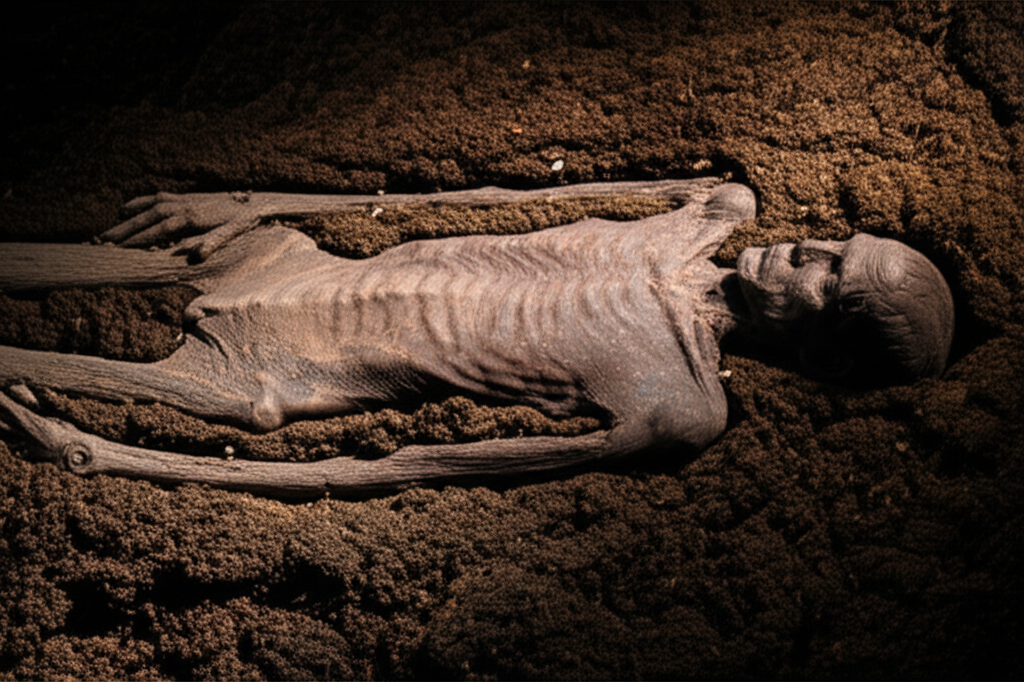
The Uneathing of Grauballe Man
In the spring of 1952, peat cutters working in the Nebel Mose of Jutland unearthed the remains of the Grauballe Man, an exceptionally preserved casualty of the late third century BC. Like many Iron Age bog bodies, the surrounding anaerobic environment, rich in sphagnum moss and humic acids, arrested the natural decay processes. Consequently, his skin, hair, and even his fingernails endured millennia of submersion. Historical analysis of his remains immediately revealed a violent end; a deep, deliberate laceration spanned his throat from ear to ear, accompanied by cranial fractures and a broken tibia.
The Ritualistic Context of Peat Burials
This discovery reinforced the prevailing archaeological hypothesis regarding Northern European bog burials. Rather than the victims of simple criminal executions, these individuals were likely participants in complex sacrificial rites. The bogs functioned as liminal zones, serving as a transitional boundary between the mortal realm and the divine. The method of dispatch frequently observed across similar discoveries demonstrates a highly structured pattern of violence:
The administration of a localized overkill, often involving strangulation, blunt force trauma, and exsanguination.
The ingestion of a specific final meal composed of diverse seeds and grains, typically indicating a winter or early spring sacrifice.
* The deliberate deposition into the watery mire, sometimes secured by wooden stakes to ensure the remains stayed submerged.
Through the meticulous examination of the Grauballe Man, historians acquired profound insights into the spiritual anxieties and agrarian cycles of the era. The remarkable preservation of his form provided an unprecedented physiological archive, allowing modern researchers to definitively map the intersection of violence, religious appeasement, and the natural environment in prehistoric Europe.