
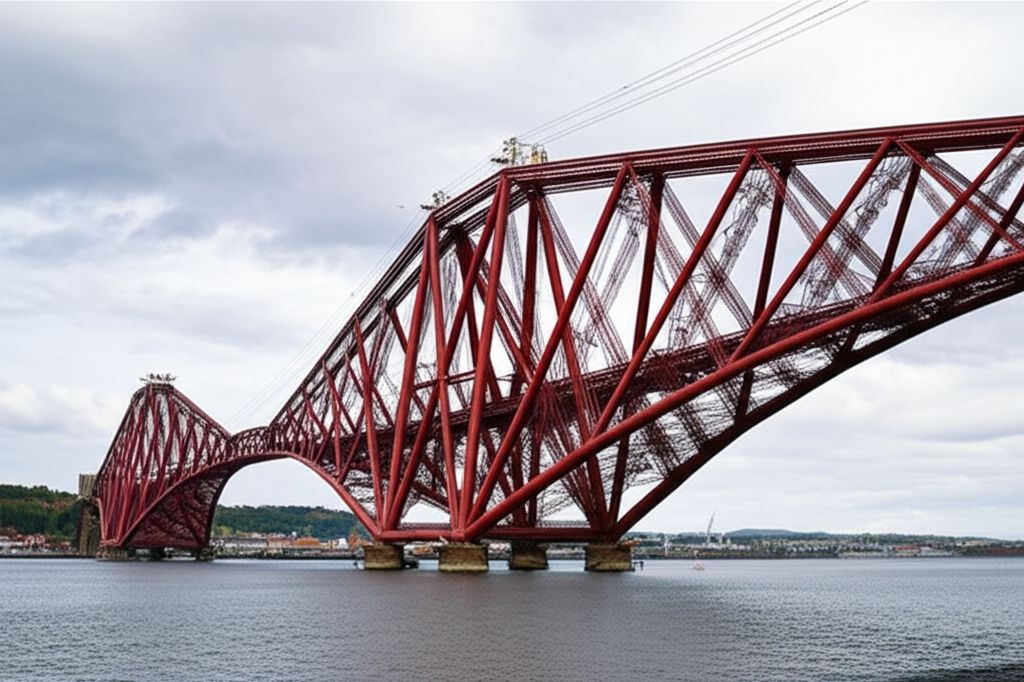
Upon its completion in 1890, the crossing of the Firth of Forth represented the zenith of Victorian industrial ambition. Designed by Sir John Fowler and Sir Benjamin Baker, the structure marked a definitive departure from the suspension designs prevalent in that era. The engineers adopted a robust Cantilever system, a strategic choice driven by the necessity to withstand immense wind pressures—a critical concern following the catastrophic failure of the nearby Tay Bridge. This approach prioritized absolute rigidity and stability over the flexibility found in suspension alternatives.
The optimization of the bridge relied heavily on the pioneering application of mild Steel rather than the traditional wrought iron. This metallurgical shift allowed for a structure of unprecedented scale, offering a superior strength-to-weight ratio essential for spanning the deep, tidal channels. The construction methodology involved building immense arms outward from the main towers, balanced perfectly to maintain equilibrium. This technique eliminated the need for temporary scaffolding in the water, which would have been impossible given the depth and current of the estuary.
To secure the massive superstructure, workers utilized Pneumatic Caissons to sink foundations seventy feet below the riverbed. The assembly process was a logistical triumph of the age, utilizing hydraulic power to drive millions of rivets with precision. The completed edifice did not merely connect two banks; it validated the efficacy of rigid long-span engineering, establishing a new global standard for heavy-load railway infrastructure that defined the latter stages of the Industrial Revolution.

