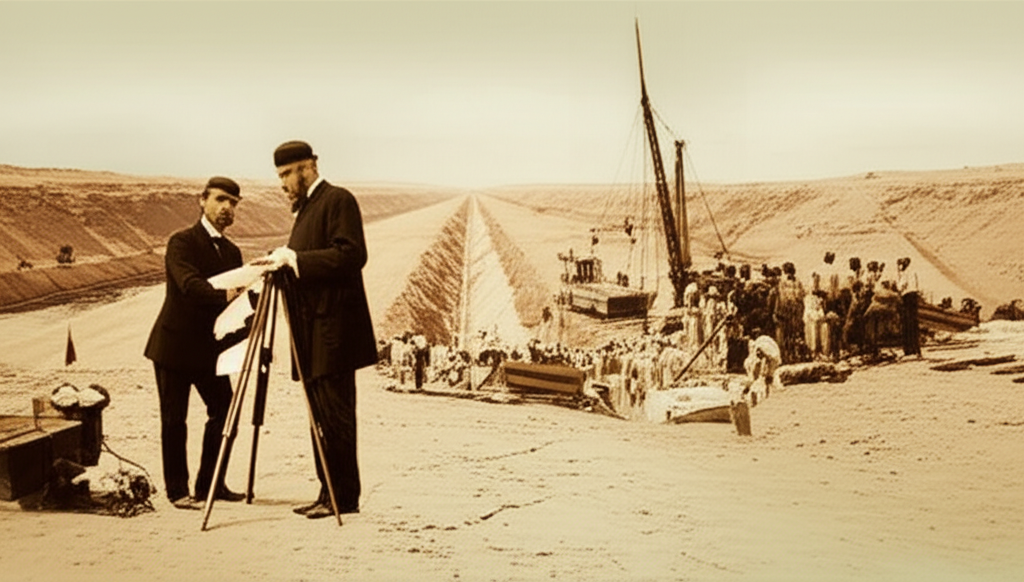
The endeavor to bisect the Isthmus of Suez was driven less by engineering innovation and more by the diplomatic tenacity of Ferdinand de Lesseps. While the French diplomat lacked technical expertise, his strategic foresight lay in capitalizing on his personal rapport with the Egyptian Viceroy, Said Pasha. This political maneuver allowed the formation of the Compagnie Universelle du Canal Maritime de Suez, securing a concession that bypassed significant geopolitical opposition, particularly from the British Empire.
Initially, the construction strategy relied heavily on the Corvée system, a form of conscripted labor that forced thousands of Egyptian peasants to dig with primitive tools. This operational model proved unsustainable and politically volatile. The pivotal moment in the canal’s development arrived when international pressure necessitated the abolition of forced labor in the early 1860s. Rather than halting progress, this labor crisis compelled a critical shift in optimization.
The project transitioned from manual excavation to industrial mechanization, marking a decisive turn in 19th-century engineering. Under the guidance of capable engineers, the company deployed custom-built steam dredgers and excavators capable of moving earth at unprecedented rates. This technological pivot was not merely a replacement of manpower but a strategic evolution that saved the project from insolvency.
By the time the waterway officially opened in 1869, the Suez Canal stood as a testament to the effectiveness of adapting industrial power to overcome logistical stagnation. De Lesseps’ ability to navigate the transition from feudal labor practices to modern machinery fundamentally altered maritime trade routes, effectively shortening the journey between Europe and Asia by eliminating the navigation of the Cape of Good Hope.