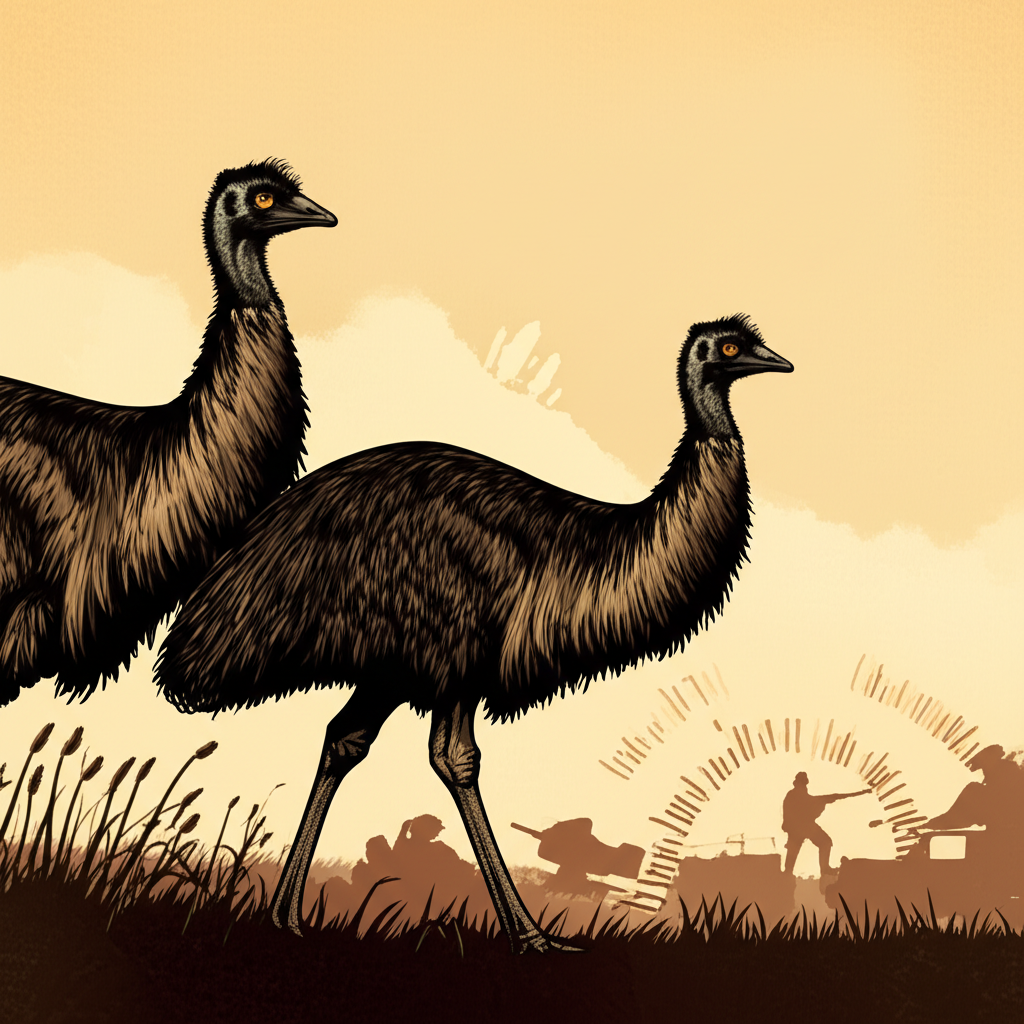
In late 1932, the government of Australia sanctioned a military operation in the Campion district of Western Australia, an engagement posthumously titled the Great Emu War. The primary objective was to cull a large and destructive emu population that had migrated into agricultural lands following a period of drought, threatening wheat crops cultivated by World War I veterans.
Under the command of Major G. P. W. Meredith of the Royal Australian Artillery, a small contingent of soldiers armed with two Lewis guns and 10,000 rounds of ammunition was dispatched. The initial military strategy presumed that concentrated machine-gun fire would be highly effective against the large flocks of birds. This assumption, however, proved to be fundamentally flawed.
The emus demonstrated remarkable tactical resilience. Upon engagement, the large flocks did not remain a cohesive unit but instead scattered into smaller groups, running at high speeds in erratic patterns. This evasive maneuver rendered the machine guns, designed for suppressing stationary or advancing infantry, largely ineffective. The soldiers found it nearly impossible to acquire and maintain targets. After several weeks of frustrating and resource-intensive efforts yielding minimal results, the operation was officially ceased. The campaign was ultimately deemed a failure, serving as a historical illustration of the inapplicability of conventional warfare tactics to a problem of wildlife management.