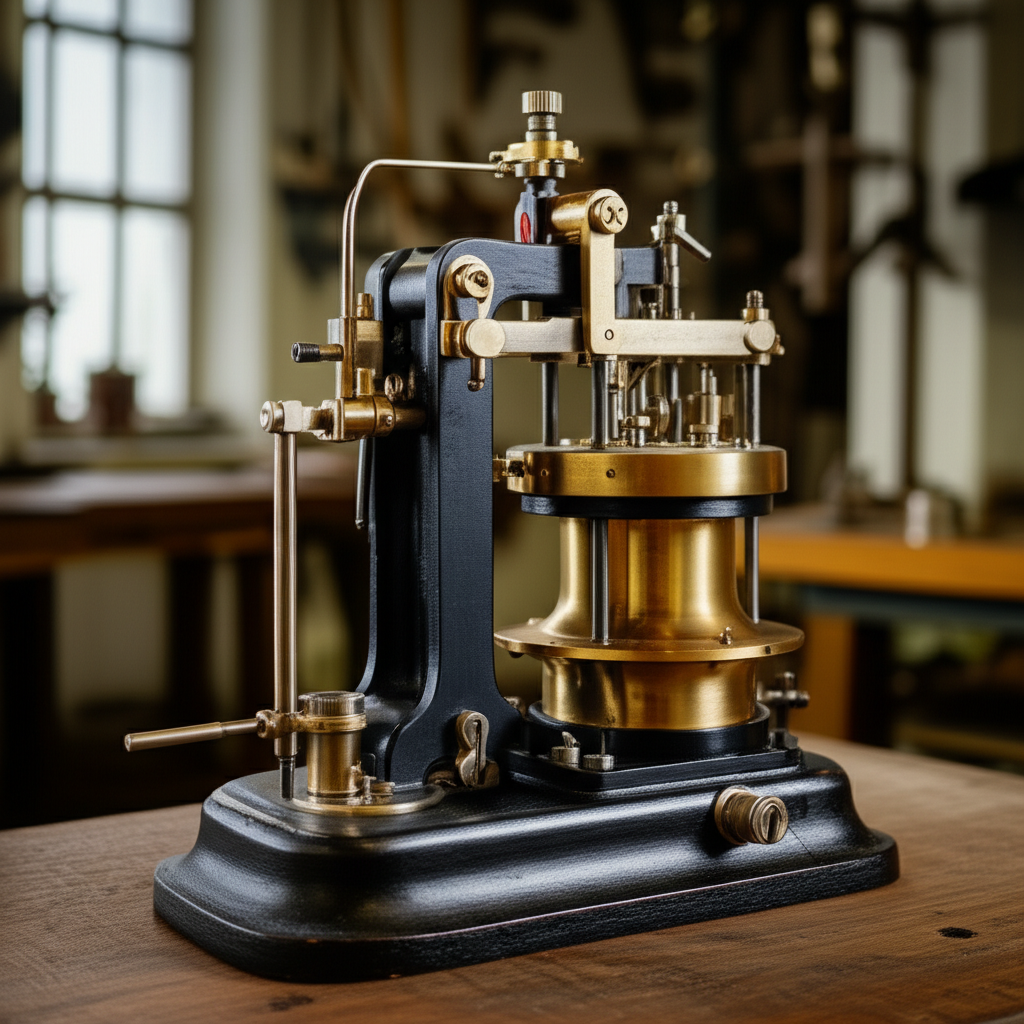
The development of the first commercially successful internal combustion engine by Étienne Lenoir in 1860 represented a significant, if flawed, advancement in motive power. Lenoir’s design was a two-stroke, double-acting engine that operated on illuminating gas. Critically, it lacked a compression stroke, a fundamental omission that severely handicapped its thermal efficiency and power output. The operational cycle involved drawing an air-fuel mixture into the cylinder for the first half of the piston’s stroke. An electric spark from a Ruhmkorff coil then ignited the mixture, driving the piston for the remainder of the stroke.
Despite its low efficiency—estimated at less than 5%—and power insufficient to supplant the steam engine in most industrial applications, the Lenoir engine established a crucial precedent. It was the first internal combustion engine to be produced in considerable numbers, demonstrating the practical viability of using controlled explosions for mechanical work.
The engine’s most notable application was in the Hippomobile, a primitive automobile that undertook a journey from Paris to Joinville-le-Pont in 1863. This event, while modest, was a profound demonstration of potential. It proved that a self-contained power plant, free from the boilers and water tanks of steam power, could propel a vehicle. Ultimately, Lenoir’s work provided the foundational, real-world platform upon which later engineers, such as Nikolaus Otto, would build to create the far more efficient engines that reshaped the world.