
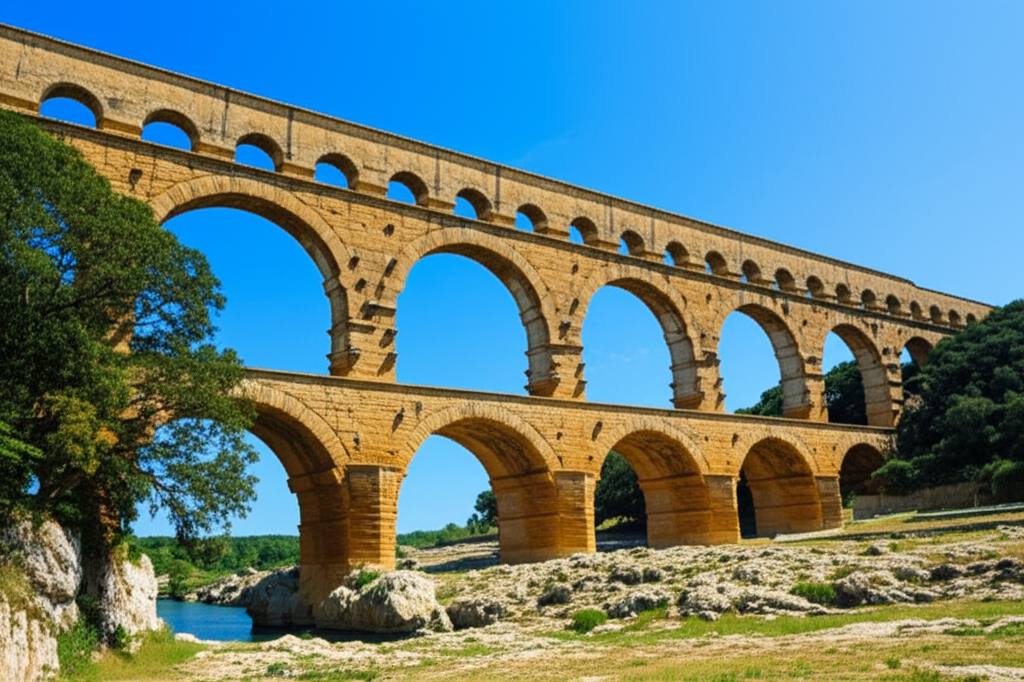
The construction of the Nîmes Aqueduct stood as a definitive testament to the precision of Roman hydraulic engineering. Faced with a rugged, irregular landscape and a destination located only slightly lower than the source at the Eure springs, the imperial surveyors employed a remarkably shallow gradient. Over a winding course of nearly fifty kilometers, the total descent measured merely seventeen meters. This calculated average decline ensured a consistent flow without generating destructive water pressure, a feat requiring the use of the chorobates and an intricate understanding of topography.
To span the formidable valley of the river Gardon, the builders erected the Pont du Gard, a three-tiered structure of imposing magnitude. Rather than relying on mortar to bind the massive blocks of shelly limestone, the artisans utilized dry masonry, depending entirely upon friction, gravity, and the precise cutting of voussoirs to maintain structural integrity. The lower and middle tiers were designed with heavy arches to carry the load, while the uppermost arcade supported the specus, or water channel. This division of labor within the stonework allowed the bridge to withstand both the vertical weight of the water and the lateral shearing forces of the winds sweeping through the valley.
Long-term utility dictated the optimization of the internal channel. The interior walls were lined with opus signinum, a waterproof mortar consisting of tiles and lime, to prevent leakage. However, the water’s high mineral content inevitably led to significant calcium carbonate deposits. Recognizing this eventuality, the design incorporated accessible inspection points and manholes, facilitating the manual removal of debris and accretion. This foresight regarding maintenance allowed the aqueduct to function efficiently for centuries, far outlasting the political stability of the empire that commissioned it.


