
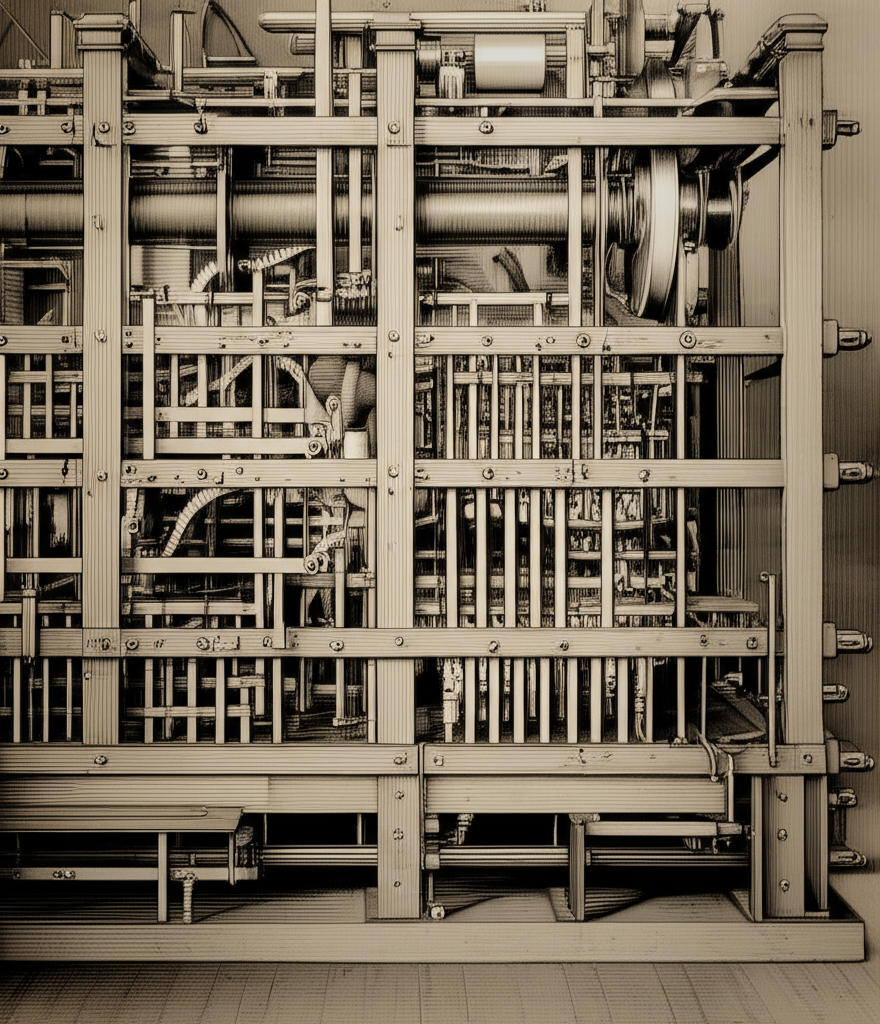
The early nineteenth century faced a critical stagnation in the accuracy of mathematical tables, a deficiency that threatened the efficacy of British navigation and engineering. Charles Babbage, a polymath of distinct foresight, recognized that the prevailing reliance on human computers was fraught with systemic error. His strategic response was not merely an improvement of manual calculation but a radical shift toward total mechanization through the invention of the Difference Engine.
Babbage grounded his design in the Method of Finite Differences, a mathematical principle that permitted the calculation of polynomial functions using only addition and subtraction. This optimization was crucial; it eliminated the need for complex multiplication and division, thereby streamlining the mechanical requirements of the apparatus. By embedding this logic into arrays of brass gears and shafts, Babbage sought to create a closed system where the output was strictly determined by the input, effectively removing the variable of human fatigue from the equation.
Despite the theoretical soundness of the engine, the physical realization encountered significant industrial hurdles. The manufacturing precision required to produce thousands of interchangeable parts was largely undeveloped at the time. Furthermore, the British government’s erratic funding and Babbage’s tumultuous relationship with his chief engineer, Joseph Clement, eventually stalled the project.
Although the Difference Engine No. 1 remained unfinished during his lifetime, Babbage’s meticulous designs established the architecture of automated computation. His work proved that mathematical law could be enforced by physical mechanism, establishing a conceptual precedent that would remain dormant until the dawn of the electronic age.
