
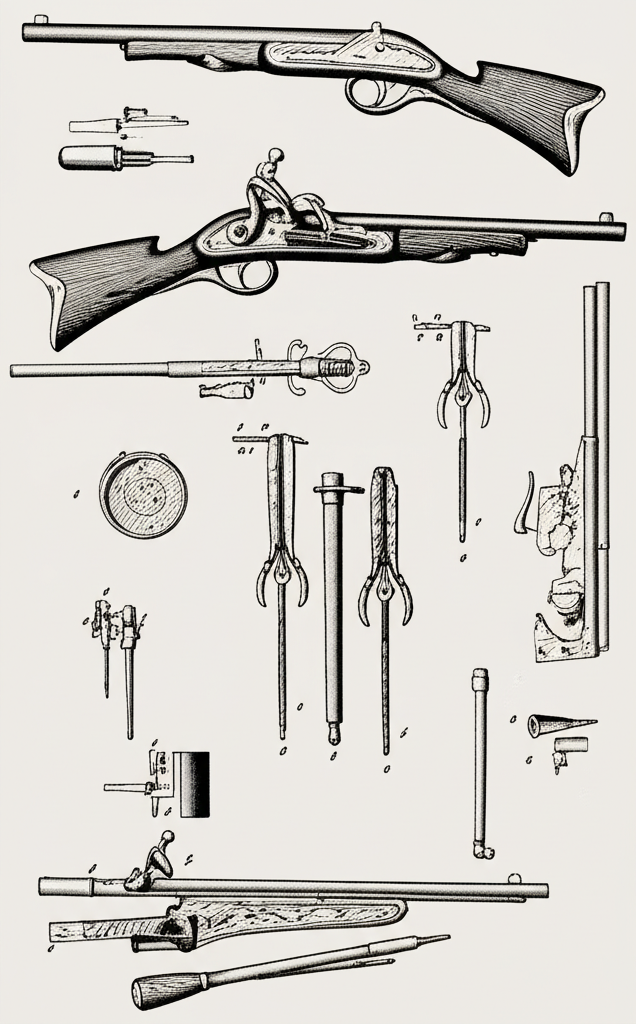
In the late eighteenth century, the trajectory of military ballistics underwent a radical paradigm shift through the engineering prowess of Bartolomeo Girandoni. A Tyrolean clockmaker by trade, Girandoni sought to overcome the inherent limitations of standard black powder weaponry—specifically the visual obstruction caused by smoke and the dangerously slow rate of fire associated with muzzle-loading muskets. His solution was the Girandoni Air Rifle, a repeating weapon that operated not by chemical combustion, but by the release of highly compressed atmospherics.
The strategic brilliance of the design lay in its utilization of a detachable, leather-wrapped iron flask which served as the buttstock. This pneumatic reservoir allowed soldiers to carry pre-charged air supplies, eliminating the reliance on dry powder and flint in adverse weather conditions. Furthermore, the integration of a gravity-fed tubular magazine facilitated a rate of fire previously unknown in infantry formations. A skilled marksman could discharge twenty rounds in under a minute, providing a tactical advantage that allowed a small unit to generate the suppression volume of a much larger platoon.
Despite its mechanical sophistication, the operational deployment of the Windbüchse by the Austrian army revealed significant logistical challenges. The specialized manufacturing required to seal the reservoirs against high pressure demanded a level of precision that was difficult to scale for mass mobilization. Although the weapon proved effective in conflicts against the Ottoman Empire and was notably leveraged during the Lewis and Clark Expedition to impress indigenous populations, the delicate nature of the valve systems eventually rendered it unsustainable for general warfare. Nevertheless, Girandoni’s invention remains a testament to early ballistic optimization, proving that pneumatic power was a viable alternative to gunpowder long before modern engineering made it commonplace.

