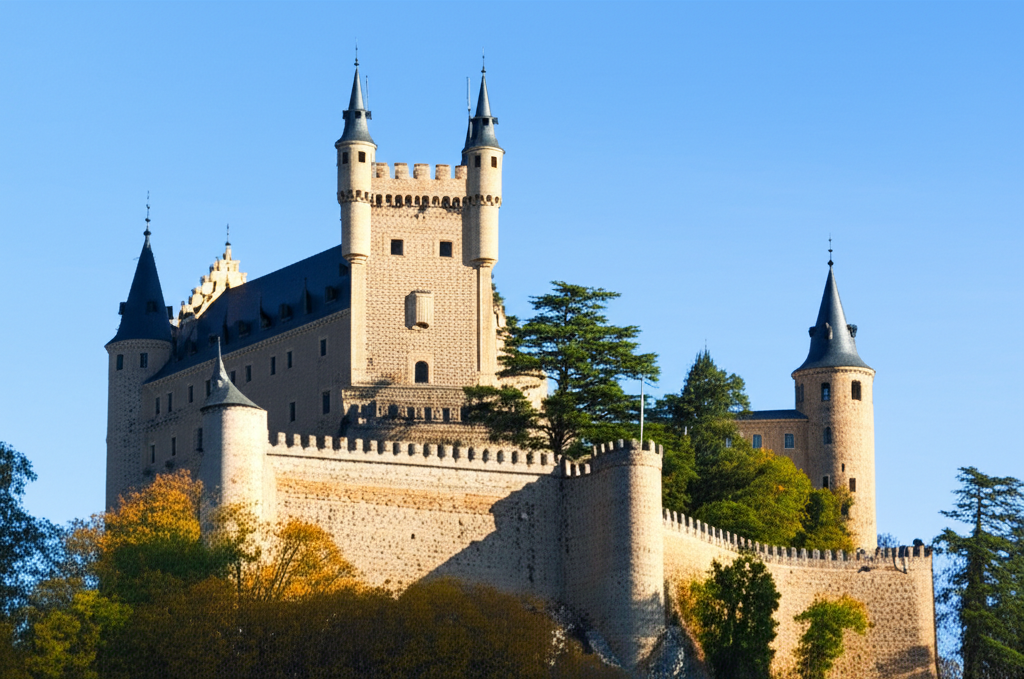
The Alcázar of Segovia stands as a testament to the complex evolution of Castilian military and residential architecture. Rising from a rocky crag at the confluence of the Eresma and Clamores rivers, the fortress initially utilized its geography for supreme defense. While the foundations dated back to Roman and Berber occupations, the definitive structure emerged during the High Middle Ages. The ruling Trastámara dynasty expanded the site significantly, transforming a utilitarian outpost into a residence of royal magnitude that prioritized political projection over mere survival.
Architectural modifications throughout the centuries reflected shifting strategic and aesthetic priorities. The sharp, slate-covered spires, added during the reign of Philip II, introduced a distinct Central European influence that differentiated the silhouette from typical Spanish fortifications. This renovation served a dual purpose: it modernized the roof against snow while establishing a visual dominance that signaled imperial power. The integration of the formidable Tower of John II alongside delicate Mudejar interiors demonstrated a synthesis of cultures, effectively merging Islamic artistry with Christian authority.
In the modern era, the fortress transcended its military origins to occupy a unique position in global visual culture. The dramatic verticality and prow-like shape of the structure provided the primary architectural inspiration for the Cinderella Castle designed by Walt Disney. This association solidified the Alcázar’s reputation as the archetypal fairy tale stronghold. However, objective analysis reveals that this romanticized image obscures a formidable history of sieges, state imprisonment, and artillery training. Ultimately, the edifice remains a paramount example of how functional defense systems were repurposed into an enduring symbol of fantasy.