The construction of the Canadian Pacific Railway (CPR) during the late nineteenth century served as the decisive geopolitical instrument in consolidating the nascent Dominion of Canada. Following Confederation, the federal government faced the strategic imperative of securing British Columbia and halting American westward expansionism. The railway was not merely an infrastructural endeavor but a calculated mechanism of statecraft designed to bind a fragmented transcontinental geography into a unified political entity. Prime Minister John A. Macdonald viewed the swift completion of the line as essential to maintaining sovereignty over the western territories.
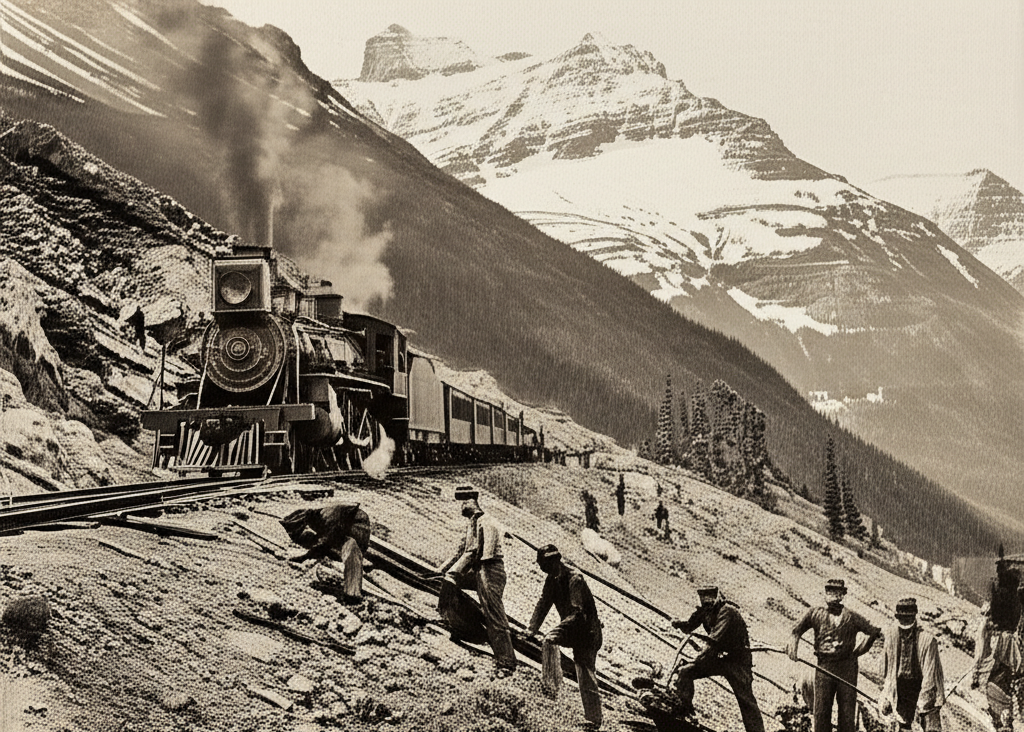
To overcome the formidable topographical barriers of the Canadian Shield and the Rocky Mountains, the CPR syndicate employed rigorous logistical optimization and aggressive fiscal maneuvering. The government granted the syndicate extensive land concessions and substantial subsidies, a strategy intended to offset the unprecedented capital risk. Engineers systematically rerouted the line through the more direct, albeit treacherous, Kicking Horse Pass. This strategic deviation from the original Fleming surveys prioritized the speed of transcontinental transit over immediate regional development. This optimized route ensured that the federal government could rapidly deploy military forces to assert authority, a capability decisively proven during the North-West Rebellion of 1885.
Ultimately, the driving of the Last Spike at Craigellachie functioned as the physical realization of the National Policy. The railway forged a continuous economic and political corridor, neutralizing external threats of annexation and internal threats of secession. By inextricably linking the industrial centers of the east with the resource-rich frontiers of the west, the CPR structurally guaranteed the territorial integrity and enduring unity of the Canadian state.