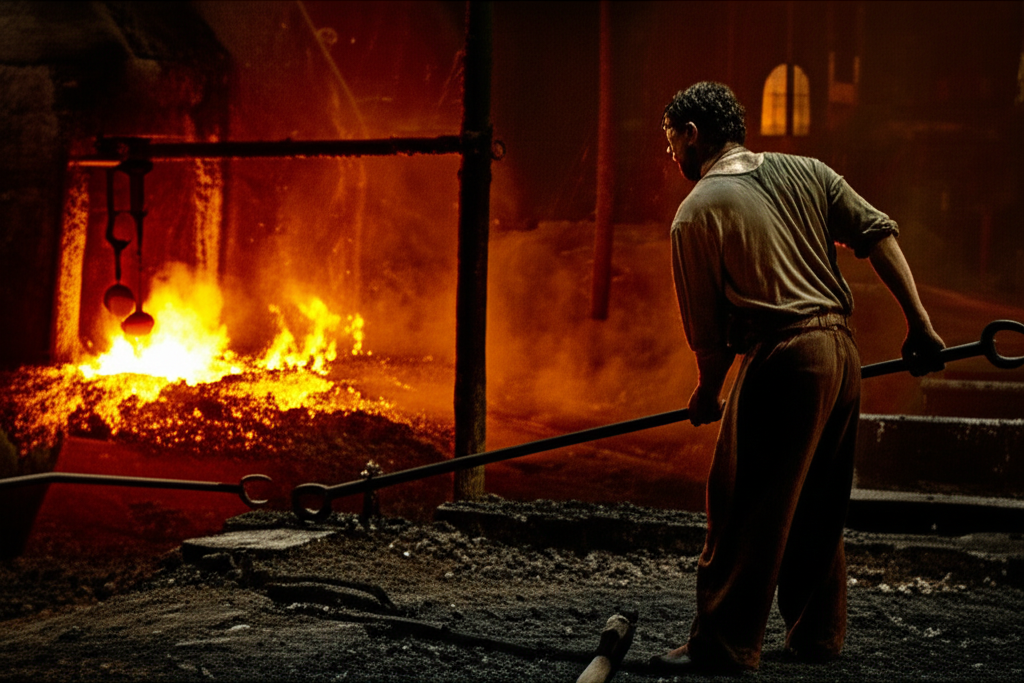
The Role of the Puddler in Iron Production
The Reverberatory Furnace dominated the landscape of the 19th-century forge, serving as the stage for the industry’s most demanding craft. Within this sphere, the Iron Puddler operated not merely as a laborer, but as a master of applied metallurgy, tasked with the critical conversion of brittle pig iron into malleable wrought iron. This process resisted mechanization for decades, relying instead on the muscular endurance and sharp observation of the artisan.
The operation demanded a strategic application of heat and motion. Through a small aperture in the furnace door, the puddler inserted a long iron tool called a Rabble. With this instrument, he agitated the molten bath, exposing the liquid metal to oxygen to burn off carbon and sulfur. This was a delicate balance; the puddler had to sense the precise moment the iron “came to nature,” thickening as it purified. Failure to maintain constant motion resulted in the metal fusing to the furnace bed, ruining the charge and wasting valuable resources.
Upon completion, the puddler gathered the semi-solid iron into heavy masses known as Puddle Balls. These glowing blooms were then extracted with great difficulty and rushed to the steam hammer for shingling. Because the quality of the final product rested entirely on their judgment, puddlers commanded high wages and held a distinct status above common mill hands. They often employed their own assistants and managed the furnace output independently. However, the extreme thermal exposure and physical strain exacted a severe price, often leading to premature physical decline and a significantly reduced life expectancy.