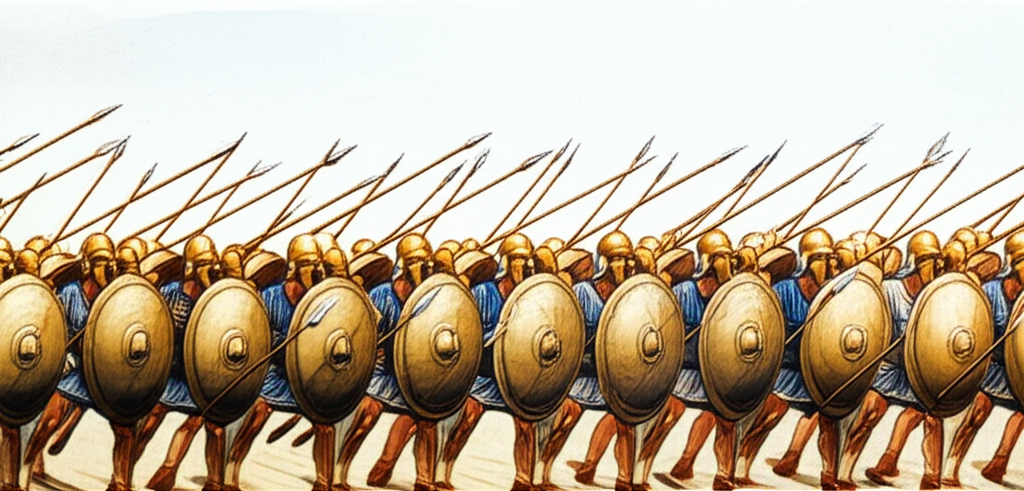
In 371 BC, the fields of Boeotia witnessed a fundamental shift in Greek military science. The Theban general Epaminondas dismantled centuries of tactical dogma during the engagement against Spartan forces, fundamentally altering the application of the heavy infantry line. Rather than adhering to the symmetrical alignment typical of the era, the Theban strategy introduced a calculated imbalance designed to overwhelm the enemy’s command structure.
The traditional phalanx relied on uniform depth, usually consisting of eight to twelve ranks, with the most capable troops stationed on the honorable right wing. Recognizing the predictability of this deployment, the Theban command executed a radical deviation known as the oblique order. Epaminondas concentrated his primary striking power on his left wing, stacking his hoplites to an unprecedented depth of fifty shields. This massed column was explicitly designed to shatter the Spartan right, where King Cleombrotus and his royal guard were positioned.
To protect his own exposed flanks, Epaminondas employed a specific maneuvering tactic:
* Refused Flank: The weaker Theban center and right wings advanced in a staggered echelon formation, keeping distance from the Spartan line to delay engagement.
When the massive Theban column collided with the Spartan shield wall, the sheer physical pressure and tactical density overwhelmed the thinner Spartan formation. The elite Sacred Band, spearheading the assault, exploited the initial shock, causing the collapse of the Spartan leadership before their superior numbers could envelop the Theban line.
This tactical optimization neutralized the legendary discipline of the Spartan infantry through geometric advantage and localized numerical superiority. The victory at Leuctra shattered the myth of Spartan invincibility and established a new precedent in military engineering, demonstrating that mass and focused force could dismantle the rigidity of traditional linear warfare.