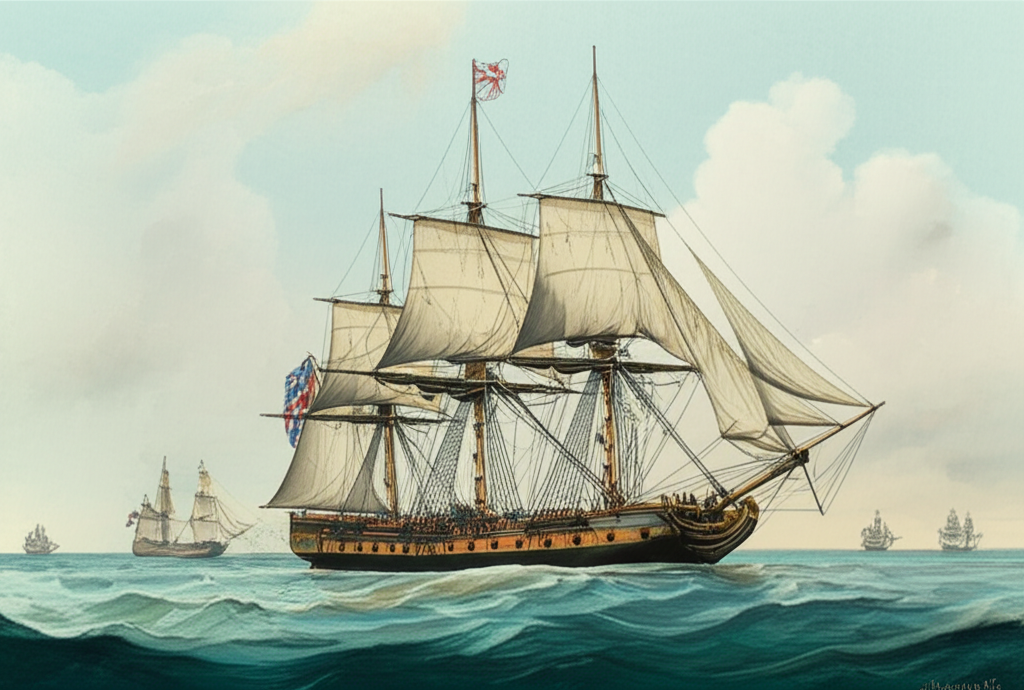
To secure its commercial monopoly across the volatile Indian Ocean, the British East India Company established a maritime force that operated distinctly from the Royal Navy. Initially raised to protect trade at Surat in the early seventeenth century, this fleet, which became renowned as the Bombay Marine, functioned as a strategic instrument for projecting power and safeguarding merchant vessels against endemic piracy and European rivals. The Company realized that profit maximization required not merely diplomatic charters but the enforcement of safe passage through contested waters.
The Marine’s strategic utility evolved rapidly during the eighteenth century. Facing the naval proficiency of the Maratha Confederacy and the Siddis of Janjira, the Company optimized its fleet for littoral warfare and convoy defense rather than open-ocean dominance alone. This adaptation allowed the Company to secure the western coast of India, transforming Bombay into an impregnable commercial hub. The commanders prioritized discipline and standardized gunnery, ensuring that smaller Company vessels could repel numerically superior indigenous fleets.
Beyond direct combat, the service institutionalized maritime dominance through scientific advancement. The Marine’s mandate expanded to include:
The suppression of local piracy to stabilize insurance premiums for merchant shipping.
The logistical support of land campaigns during the Anglo-Mysore wars.
* The extensive hydrographic charting of the Persian Gulf and Red Sea routes.
By the time the force was re-designated as the Indian Navy in 1830, it had successfully established naval supremacy, effectively serving as the policing arm of the Company’s vast economic empire until the eventual transfer of power to the British Crown.