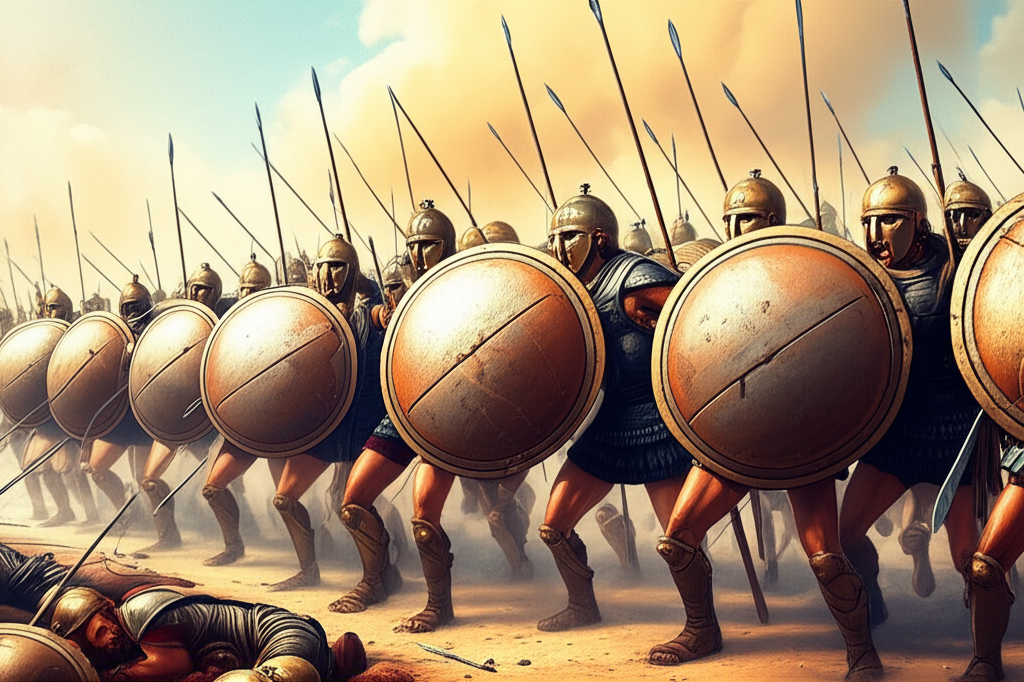
At the plain of Marathon in 490 BC, the Athenian commanders faced a critical strategic necessity: they had to stretch their battle line to match the length of the opposing Persian forces. To prevent being outflanked by the numerically superior enemy, General Miltiades orchestrated a calculated deviation from standard Hoplite Phalanx doctrine. Rather than maintaining the customary uniform depth of eight shields, the Greek center was dangerously thinned to merely four ranks, while the wings retained their full density and striking power.
This disposition was not an act of desperation, but a deliberate tactical trap. When the engagement commenced, the Greeks executed a rapid advance to minimize exposure to Persian archery. Upon impact, the intentionally weakened Greek center buckled under the weight of the Persian elites and Saka troops. However, this retreat was disciplined, serving to draw the enemy deeper into the Greek formation while maintaining unit integrity.
As the Persians surged forward, believing the Greek line had shattered, the strengthened Athenian and Plataean wings routed the lighter Persian infantry on the flanks. With disciplined precision, these heavy wings then wheeled inward, executing a classic Double Envelopment. The Persian center, suddenly compressed from both sides and deprived of mobility, lost all formation cohesion. The resulting panic led to a catastrophic rout, demonstrating that the phalanx was not merely a static wall of bronze, but a flexible instrument capable of complex optimization when directed by superior strategic foresight.