
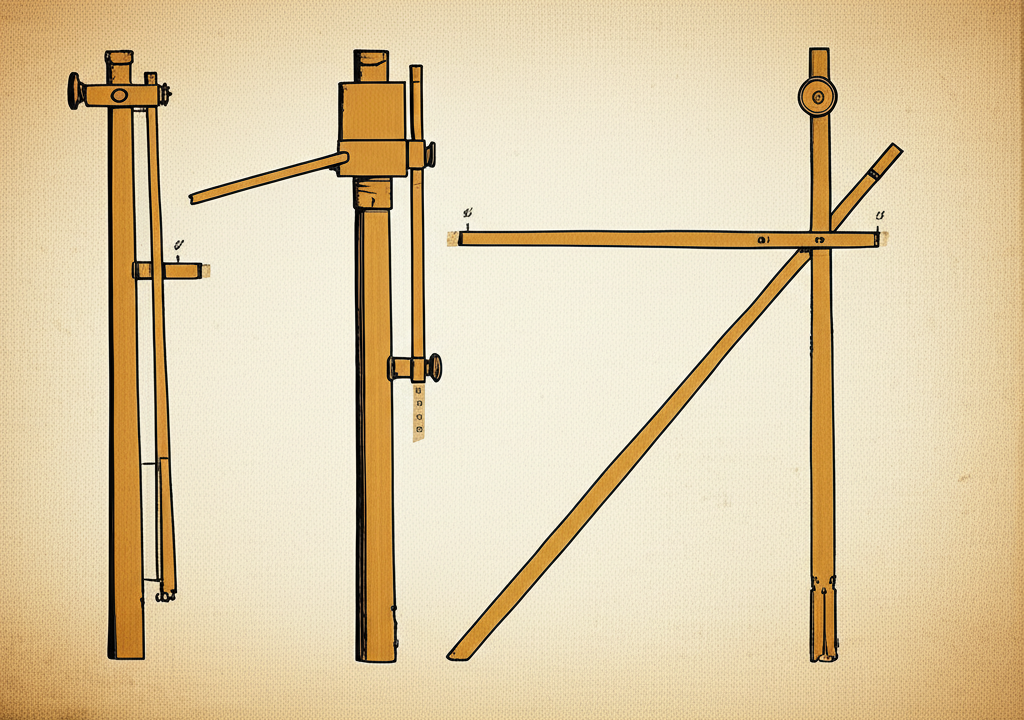
The maritime implementation of the Jacob’s Staff represented a pivotal advancement in celestial navigation during the Age of Discovery. While initially favored for observing the Pole Star, navigators faced significant physiological hazards when attempting to determine solar altitude. The instrument, consisting of a main staff and a sliding cross-piece called the transom, relied on the geometric principle of similar triangles to measure the angle between the horizon and the sun.
Optimizing the device for solar readings required strict procedural discipline. Navigators often equipped the staff with multiple transoms of varying lengths to accommodate different degrees of elevation, ensuring greater precision during seasonal shifts in the sun’s declination. The primary strategic challenge lay in the observer’s need to look simultaneously at the dazzling solar disk and the horizon. To mitigate the risk of blindness, mariners adopted the use of smoked glass or semi-transparent distinct filters attached to the vane.
Furthermore, the specific technique of placing the staff’s base against the cheekbone—rather than the eye socket—served to stabilize the instrument against the ship’s roll while correcting for parallax error. This adjustment allowed for a more consistent geometric baseline, essential for accurate latitude calculations.
Although the Jacob’s Staff was eventually superseded by the backstaff, which allowed navigators to face away from the sun, its development marked a sophisticated era of utilizing trigonometry to master the open ocean. The rigorous application of this tool demonstrated early modern attempts to harmonize abstract mathematics with the physical demands of seafaring.


