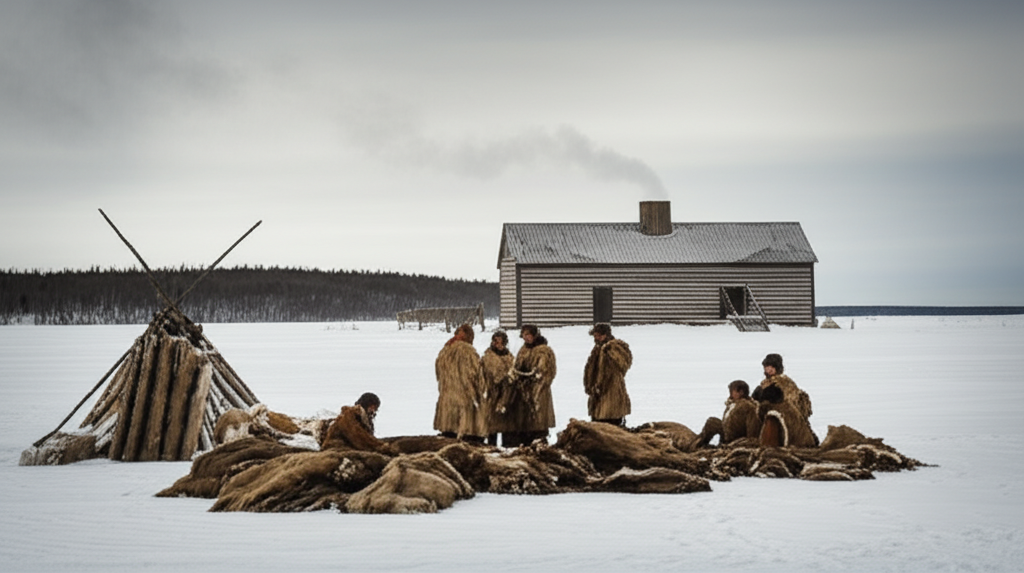
Established by the Royal Charter of 1670, the Hudson’s Bay Company (HBC) secured an unprecedented commercial monopoly over the vast drainage basin known as Rupert’s Land. This grant provided a strategic advantage that defined the economic landscape of northern North America for two centuries. Rather than mere exploration, the company’s initial operations relied on a highly efficient, though rigid, logistics network anchored by coastal fortresses. These “factories” allowed the HBC to centralize inventory and standardize exchange rates, effectively forcing suppliers to transport goods to the shores of Hudson Bay.
However, the company’s dominance faced substantial challenges from the Montreal-based North West Company. This rivalry necessitated a sharp shift in tactical operations. The competitors utilized a decentralized model, aggressively intercepting furs directly from Indigenous trade networks deep in the interior before they could reach the bay. In response, the HBC was compelled to abandon its passive coastal policy, establishing inland posts to shorten supply lines and secure territory. This expansion optimized the flow of pelts and solidified the company’s influence over the region’s geopolitics.
The eventual amalgamation of these rival entities in 1821 marked the definitive consolidation of corporate power. By streamlining supply chains and eliminating redundant competition, the reorganized entity achieved a level of market control rarely seen in colonial history. The resulting administrative structure governed a territory larger than many European nations, transforming the fur trade from a rugged frontier venture into a sophisticated, continental enterprise rooted in logistical supremacy.