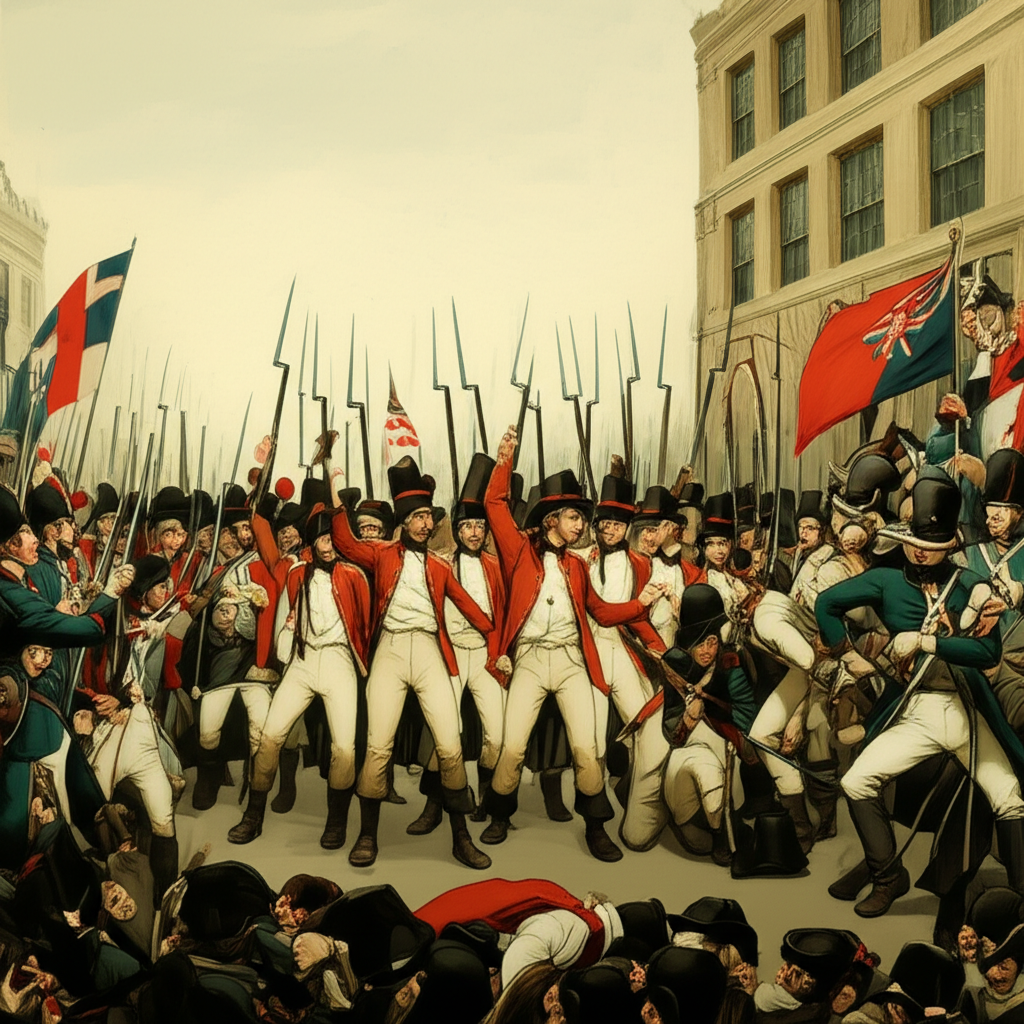
The Catastrophe at St Peter’s Field
On August 16, 1819, the industrial workforce of Manchester convened at St Peter’s Field to demand Parliamentary Reform. Unlike the chaotic riots feared by the establishment, this assembly demonstrated a sophisticated level of organization. Tens of thousands marched in military-style formations, displaying a strategic discipline intended to legitimize their cause for universal suffrage and the repeal of restrictive economic policies. The presence of radical orator Henry Hunt served as the focal point for this peaceful demonstration of political strength.
Local magistrates, viewing the sheer magnitude of the crowd as an insurrectionary threat, ordered the Manchester and Salford Yeomanry to arrest the speakers. This tactical decision proved disastrous. Ill-trained and hostile toward the reformers, the cavalry charged into the dense throng, hacking with sabres and trampling civilians. The subsequent deployment of the 15th Hussars to disperse the crowd transformed a political rally into a slaughter. Within moments, the field was strewn with the casualties of an unprovoked assault on unarmed subjects.
The government’s immediate response was one of repression rather than conciliation. Parliament passed the Six Acts, aiming to suppress radical meetings and seditious literature. However, the bloodshed at “Peterloo”—an ironic comparison to the Battle of Waterloo—galvanized the reform movement. The event stripped the authorities of moral legitimacy and solidified the resolve of the working class. While immediate change was stifled, the tragedy became a defining catalyst that eventually necessitated the Great Reform Act of 1832, fundamentally altering the British political landscape.