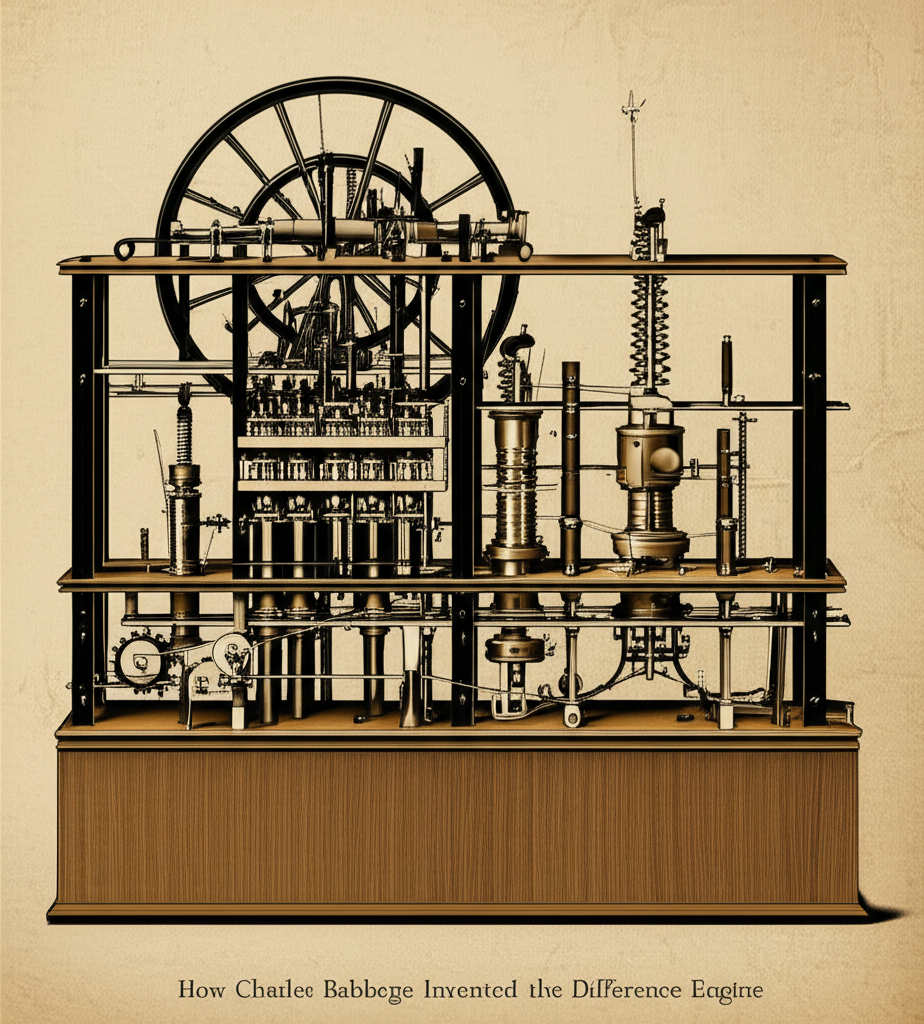
In the landscape of nineteenth-century mathematics, the prevalence of erroneous data within logarithmic tables posed a significant threat to scientific and maritime progress. Charles Babbage, a polymath of distinct vision, sought to eradicate human fallibility through the conceptualization of the Difference Engine. His strategy relied not merely on calculation, but on the mechanization of the Method of Differences, a polynomial interpolation technique that avoided the complexities of multiplication and division in favor of repeated addition.
Babbage’s approach was essentially an exercise in industrial optimization applied to abstract mathematics. By reducing complex functions to a series of mechanical interactions, he intended to automate the production of tables directly into print, thereby removing the potential for typesetting errors. This ambition required an unprecedented level of engineering precision. The resulting machine architecture demanded interchangeable parts and tolerancing standards that challenged the manufacturing capabilities of the Victorian era.
Despite significant capital investment from the British government, the project suffered from administrative friction and disputes with chief engineer Joseph Clement. While the complete machine remained unfinished during his lifetime, Babbage’s rigorous analysis of control flow and mechanical logic transcended the immediate failure. The intellectual framework established by the Difference Engine served as the critical precursor to his more advanced Analytical Engine, effectively marking the genesis of programmable computation.