The high Andes served as the backdrop for the Muisca Confederation, a civilization that valued spiritual equilibrium and political stability. Central to their governance was the investiture of the zipa, or ruler, a ceremony deeply entwined with the sacred waters of Lake Guatavita. While European chroniclers later distorted these events into the feverish hunt for a golden city, the original practice represented a calculated display of divine favor and political legitimacy.
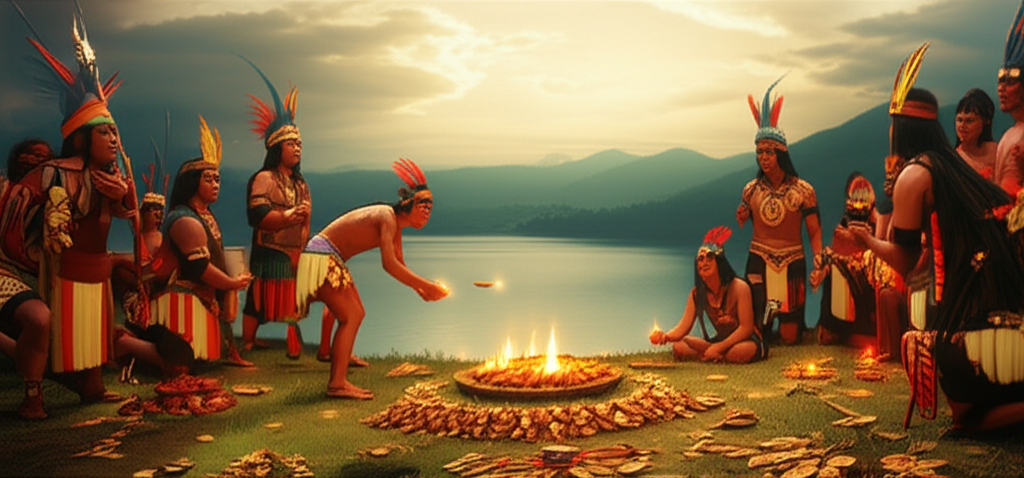
The ceremony of El Dorado—literally “The Gilded Man”—required the ruler to be coated in resin and dusted with gold powder until he resembled a living statue. This was not mere vanity but a strategic ritual to harmonize with the gods. Upon a ceremonial raft, the zipa drifted to the center of the crater lake. There, amid smoke and chanting, vast quantities of gold and emeralds were consigned to the deep. This act functioned as a mechanism of social cohesion, reinforcing the ruler’s power through the conspicuous offering of wealth to the water deity.
European interest shifted quickly from observation to extraction. The legend prompted various engineering endeavors to optimize the recovery of these submerged treasures. Notable among these was the attempt by Antonio de Sepúlveda in the sixteenth century, who cut a notch in the crater rim to lower the water level. Although partially successful in recovering artifacts, the logistical challenges of the terrain and the depth of the silt ultimately thwarted a complete excavation. The lake retained the majority of its secrets, leaving the true nature of the ritual obscured by the myth of infinite riches.