Within the industrial hierarchy of the Victorian ironworks, the Puddler commanded a respect disproportionate to his grueling labor. He was not merely a laborer but a craftsman of fire, entrusted with the critical chemical transformation of brittle Pig Iron into malleable Wrought Iron. This conversion required an intuitive understanding of thermal dynamics within the Reverberatory Furnace, a sophisticated apparatus where the fuel source remained separated from the metal to prevent contamination.
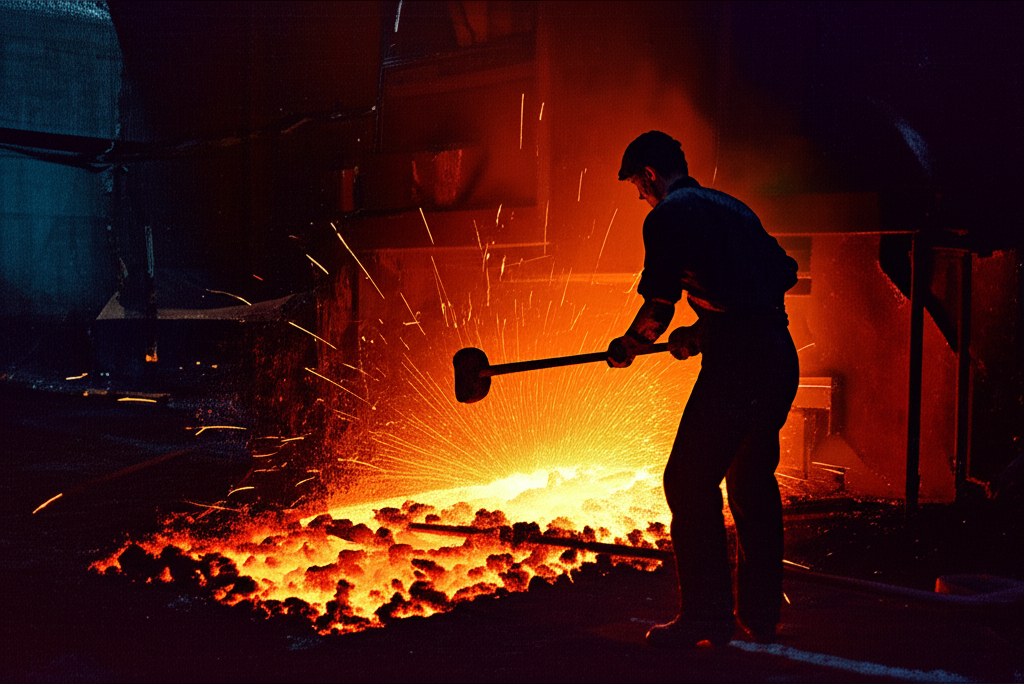
The operation demanded strategic pacing and immense physical endurance. Once the charge melted, the puddler engaged in the exhausting task of agitation. Using a long iron tool known as a Rabble, he stirred the molten bath to expose silicon and carbon to atmospheric oxygen. Success relied on maintaining a specific viscosity; excessive heat risked melting the furnace lining, known as Fettle, while insufficient temperature stalled the reaction. The puddler monitored the “boil” by eye, interpreting the shifting hues of the flames and the consistency of the metal to judge the precise moment of decarburization.
As the iron “came to nature,” solidifying into pasty lumps, the physical demand peaked. The puddler gathered these semi-solid masses into blooms destined for the shingling hammer, working in temperatures often exceeding 3,000 degrees Fahrenheit. The toll on the human body was absolute; extreme dehydration and heat exhaustion were constant threats, and few men in this trade worked beyond their fifth decade. With the eventual rise of the Bessemer process, this reliance on individual stamina and empirical metallurgy faded, marking the end of an era defined by the direct confrontation between flesh and fire.