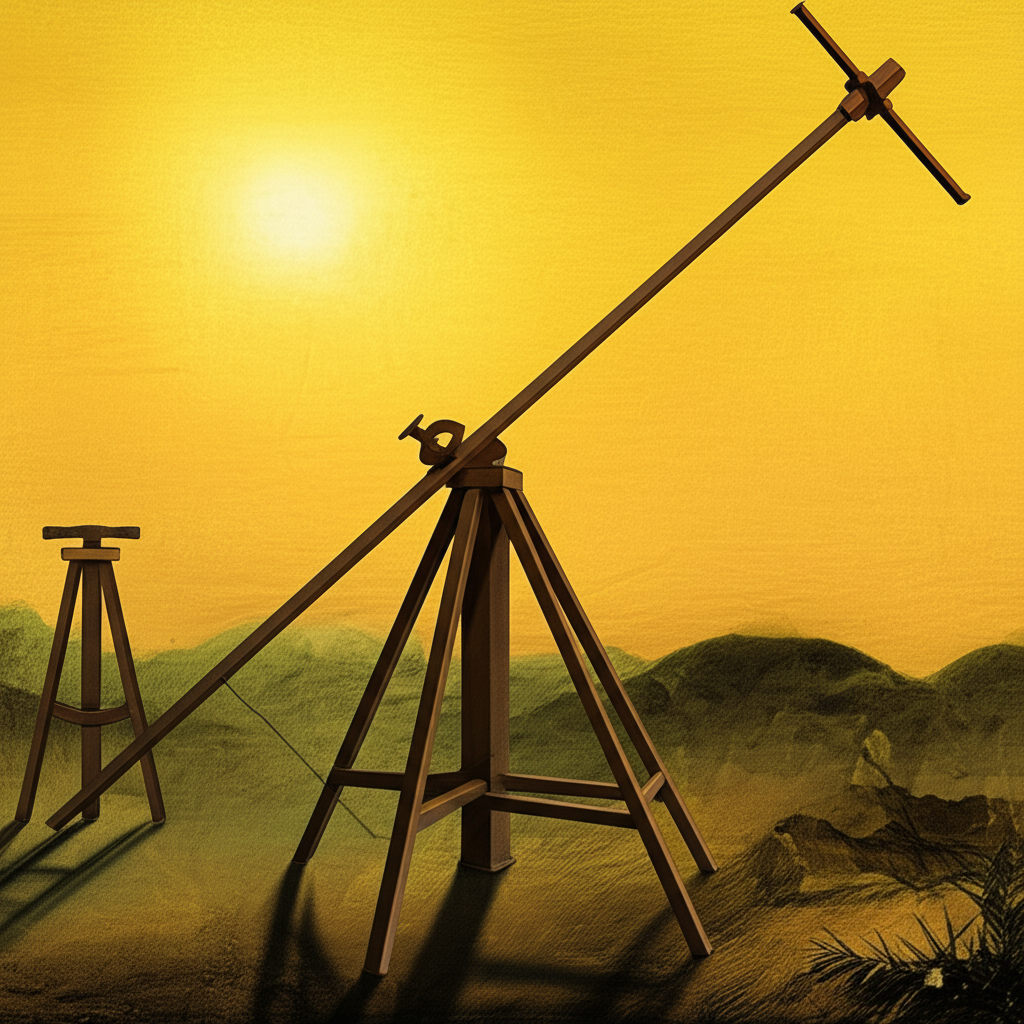
The introduction of the cross-staff, occasionally referred to as the radius astronomicus, marked a significant departure from the curved scales of the maritime quadrant. While its utility for stellar observation was immediate, its application for solar measurements required distinct operational strategies. Navigators sought to determine latitude by measuring the altitude of the sun at its zenith, a task that demanded precise geometric alignment.
To execute this, the observer positioned the end of the main staff against the cheekbone, sliding the perpendicular transom until its upper edge aligned with the center of the sun and the lower edge touched the visible horizon. This linear approach allowed for greater portability and durability compared to earlier instruments. However, the direct observation method presented severe physiological risks. The intense glare of the solar disc necessitated the development of ocular protection to prevent blindness.
Historical records indicate that early modifications involved fitting pieces of smoked glass or darkened crystal to the sighting vane. This optimization was intended to preserve the navigator’s vision while maintaining measurement accuracy. Furthermore, the geometry of the device demanded careful handling of ocular parallax. As the user’s eye could not simultaneously focus on the near vane and the distant horizon, errors in alignment were frequent. Skilled observers mitigated this by oscillating the instrument slightly to verify the points of contact. Despite these inherent difficulties, the cross-staff remained a primary tool for centuries, serving as the essential bridge between the astrolabe and the eventual adoption of the backstaff.