During the tumultuous era of the 4th century BC, the limitations of standard pyrotechnic signaling became a tactical liability for Hellenic armies. While fire beacons could alert allies to an event, they failed to convey specific intelligence regarding enemy movements or supply requirements. To bridge this informational gap, Aeneas Tacticus devised the hydraulic telegraph, a mechanism that harmonized distinct physical locations through the synchronized flow of water.
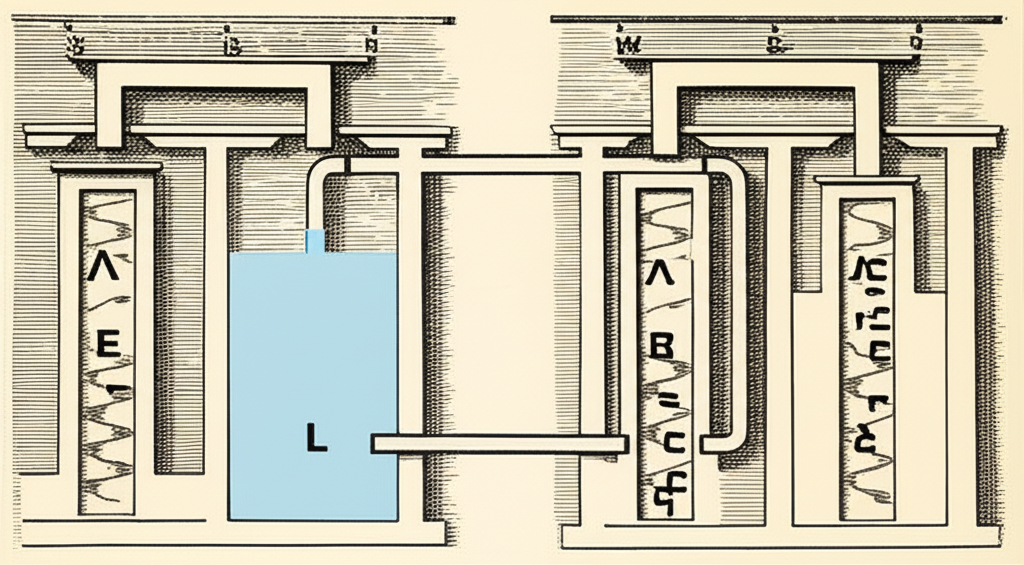
The apparatus relied on pairs of identical earthen vessels, precisely calibrated to hold equal volumes of liquid. Within these containers floated a cork base supporting a vertical rod, inscribed with pre-determined military contingencies such as “heavy infantry,” “ships,” or “corn.” The genius of the system lay not in the vessels themselves, but in the strict optimization of timing and standardization.
Operational execution demanded rigorous discipline. Upon a signal torch’s illumination, operators at distant stations simultaneously opened valves to drain the water. As the fluid receded, the inscribed rod descended. Once the water level aligned with the specific message intended for transmission, the sender lowered their torch, signaling the receiver to halt the outflow immediately.
This method effectively converted time into information. By standardizing the rate of hydraulic discharge, commanders could transmit complex strategic orders across vast distances with minimal latency. This innovation proved instrumental during conflicts such as the Sicilian Wars, allowing military leaders to coordinate maneuvers that simpler beacon fires could never articulate. The system represented a significant leap in logistical efficiency, prioritizing actionable data over mere warning signals.