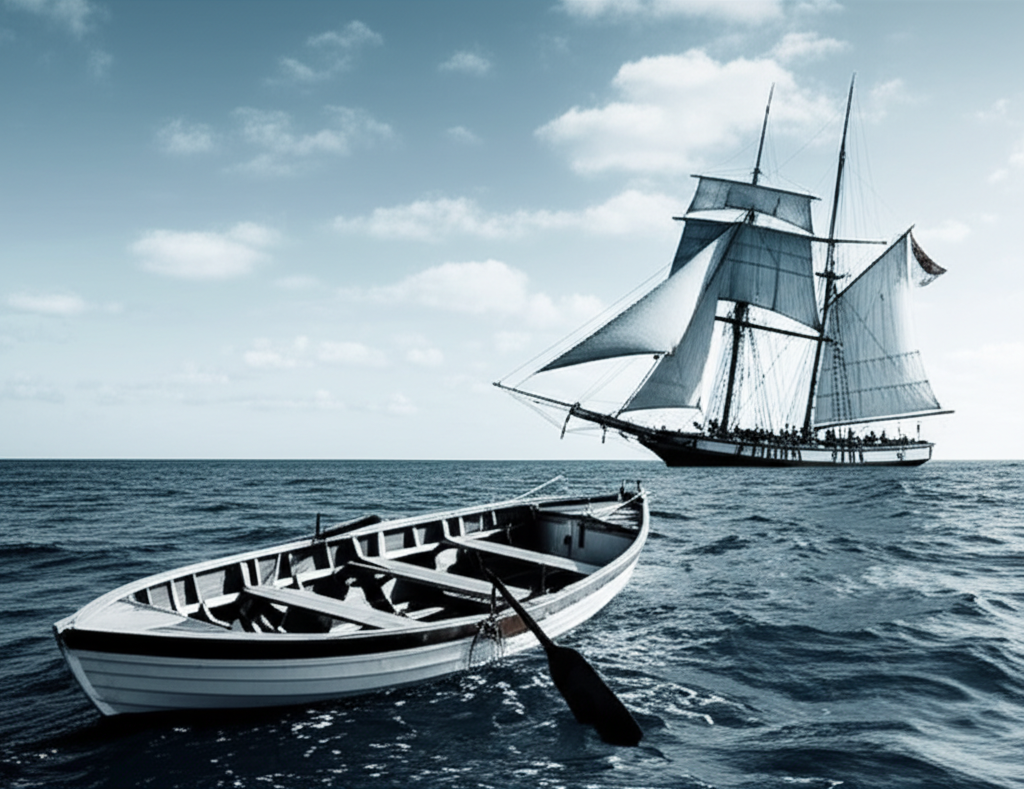
The 19th-century Nantucket whaler was a participant in a formidable global industry, undertaking voyages that often spanned three to five years. These expeditions were not simple hunts but complex logistical and economic ventures, driven by the world’s demand for whale oil. The social structure aboard a whaleship was a rigid hierarchy, dictated by the lay system, which allocated shares of the final profit according to rank and experience. This system incentivized every man, from the captain to the lowest-ranking greenhand, to maximize the voyage’s yield, as his own fortune was directly tied to the success of the hunt.
The pursuit and processing of a whale was a masterclass in industrial efficiency at sea. Upon the sighting of a sperm whale, the chase boats were lowered with practiced speed. The hunt was a coordinated and perilous affair requiring immense skill from the entire boat crew, culminating in the harpooner’s crucial strike. Once the leviathan was brought alongside the mothership, the crew engaged in the arduous process of “cutting-in.” The blubber was stripped and rendered into oil using the deck-mounted brick try-works, transforming the vessel into a floating factory that operated continuously until every valuable part of the whale was processed.
Life was a cycle of intense, dangerous labor punctuated by long periods of monotony. The whaler’s existence was one of profound isolation and hardship, governed by the singular objective of filling the ship’s barrels. This relentless pursuit established Nantucket as a whaling capital but came at a significant human cost, forever shaping the island’s economic and cultural history.