
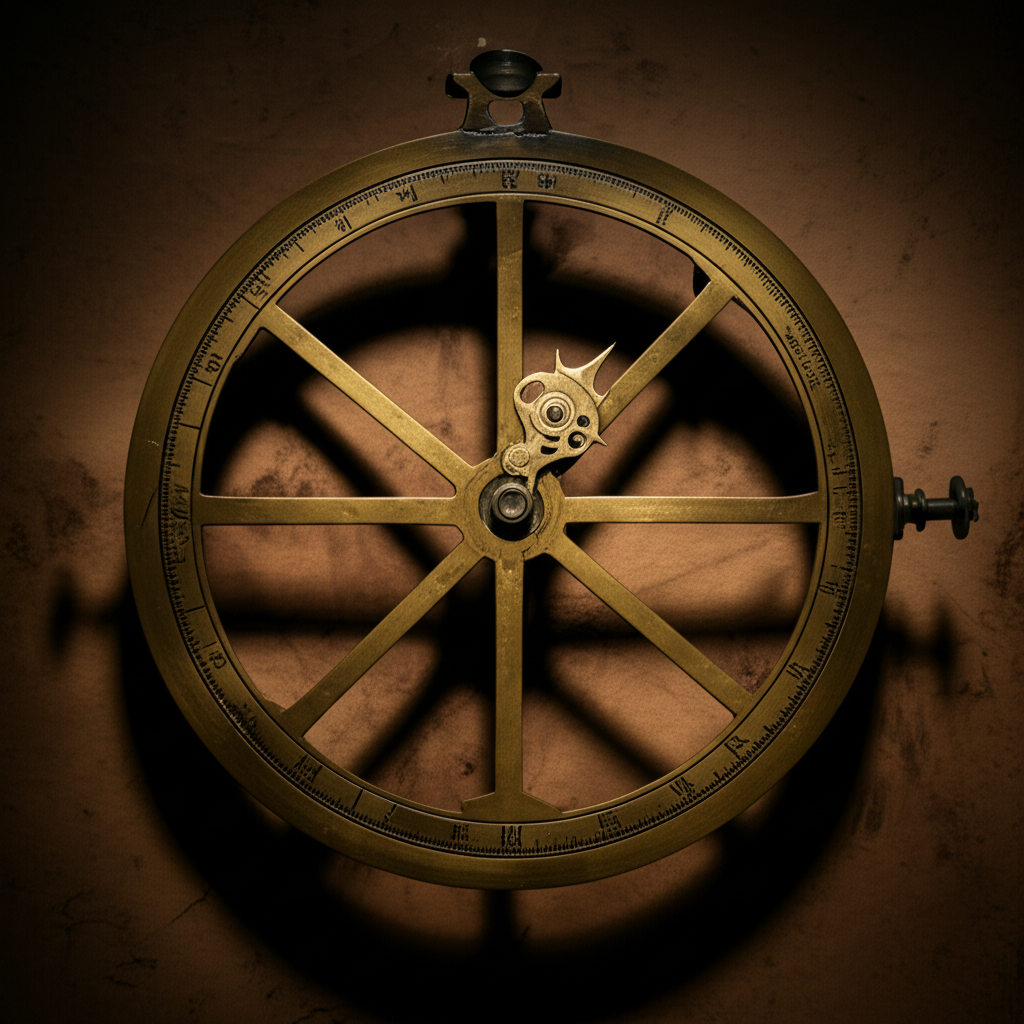
The evolution of maritime navigation during the 15th and 16th centuries was profoundly influenced by the refinement of existing astronomical tools for practical application at sea. The Mariner’s Astrolabe stands as a principal example of this strategic adaptation. Derived from the more complex planispheric astrolabe used by astronomers, this instrument was deliberately simplified to perform a single, critical function: measuring the altitude of celestial bodies above the horizon.
The design was optimized for the harsh conditions of a ship at sea. Constructed from heavy brass or bronze, its substantial weight provided stability, ensuring it hung vertically despite the vessel’s pitch and roll. The frame was often cast with large openings to minimize wind resistance, which could otherwise corrupt a reading. This specialized construction allowed a navigator to sight the sun at noon or the Pole Star at night with a degree of accuracy previously unattainable on a moving deck.
By determining the altitude of these fixed celestial points, a mariner could calculate the ship’s latitude with reasonable precision. This capability was a foundational element of the systematic, long-distance oceanic voyages that characterized the Age of Discovery. While eventually superseded by more sophisticated instruments like the backstaff and sextant, the mariner’s astrolabe represented a crucial technological advancement that enabled the expansion of known maritime routes and transformed the very nature of global exploration.

