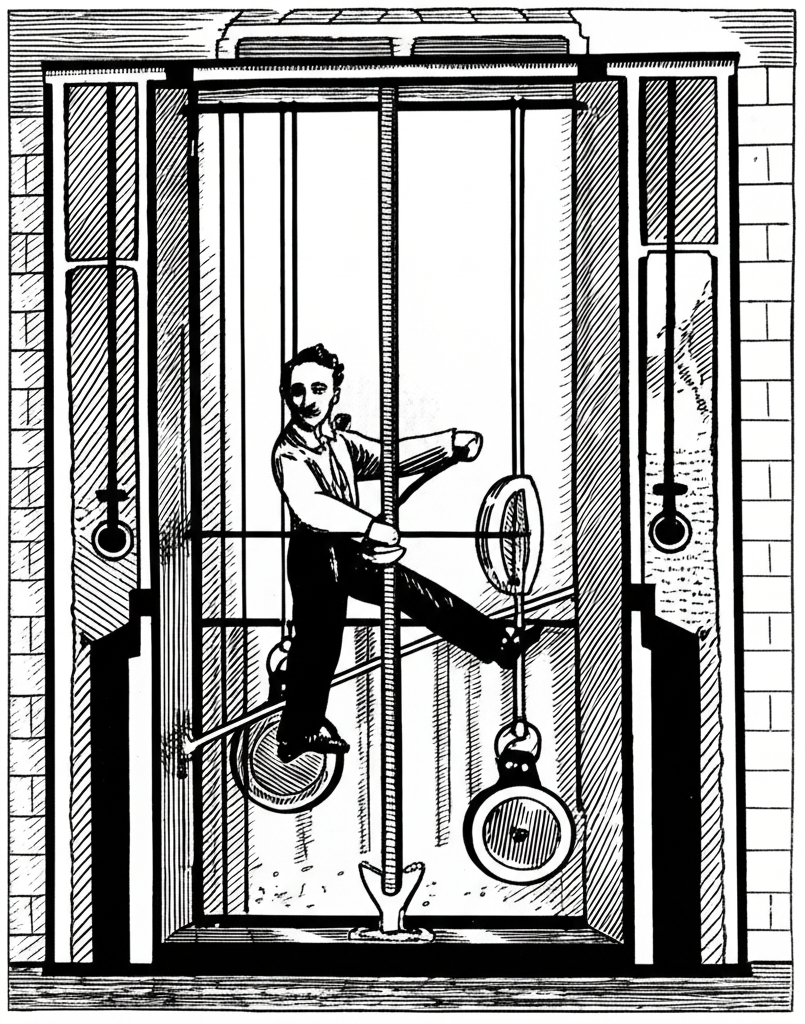
In the mid-19th century, rudimentary freight hoists were common, yet their inherent danger posed a significant barrier to widespread adoption, particularly for human transport. The prevailing apprehension was not unfounded, as a frayed rope meant certain catastrophe. It was within this context that Elisha Otis engineered a solution of profound simplicity and effectiveness. His invention, the safety brake, was a durable spring mechanism designed to engage with notched guide rails in the event of a rope failure, arresting the platform’s fall. However, Otis’s true genius lay not only in the mechanics but in his strategic public demonstration at the 1854 New York World’s Fair, where he dramatically severed the hoist rope to a platform on which he stood, securing public trust in an instant.
The successful demonstration of the safety elevator marked a critical turning point in architectural history. By vanquishing the pervasive fear of mechanical ascent, Otis’s device made the construction of taller buildings commercially viable for the first time. Architects were no longer constrained by the number of flights a person could reasonably be expected to climb. This innovation directly enabled the rise of the skyscraper, fundamentally reshaping the skylines of cities across the globe. The vertical city, with its dense concentration of commerce and residency, became a practical reality, built upon the foundation of a single, crucial invention that guaranteed a safe journey upward.