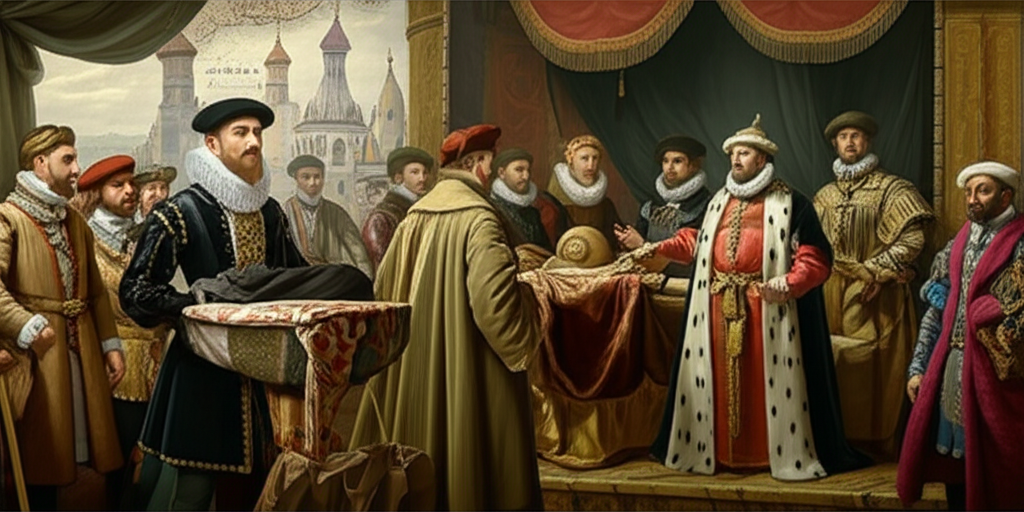
The Muscovy Company, chartered in 1555, quickly established a trade relationship with the Tsardom of Russia that was as much a diplomatic endeavor as it was a commercial one. The company’s success was not merely a matter of exchanging goods but of carefully managing its privileged status with the Tsars, beginning with Ivan IV. This exclusive right to trade via the White Sea route was the cornerstone of its strategy, a monopoly that had to be perpetually defended against both domestic rivals and foreign interlopers, particularly the Dutch.
Central to the company’s operational strategy was the cultivation of favor within the Tsar’s court. The exchange of English woolen cloth for Russian furs, wax, and naval stores was the economic engine, but the relationship was secured through offerings of strategic value. The English provided military supplies, skilled artisans, and physicians, effectively making the company an indispensable resource for the Russian state. This elevated the company’s agents beyond mere merchants; they were unofficial envoys who navigated a complex political environment where commercial privileges could be granted or rescinded by autocratic whim.
This dynamic required constant adaptation. The company’s directors in London had to balance the pursuit of profit with the geopolitical realities of Muscovy. They understood that their fortunes were intrinsically linked to the stability of the Tsarist regime and its perception of English utility. Therefore, their long-term strategy involved embedding the company so deeply within Russia’s economic and strategic framework that its expulsion would be detrimental to the Tsar himself.