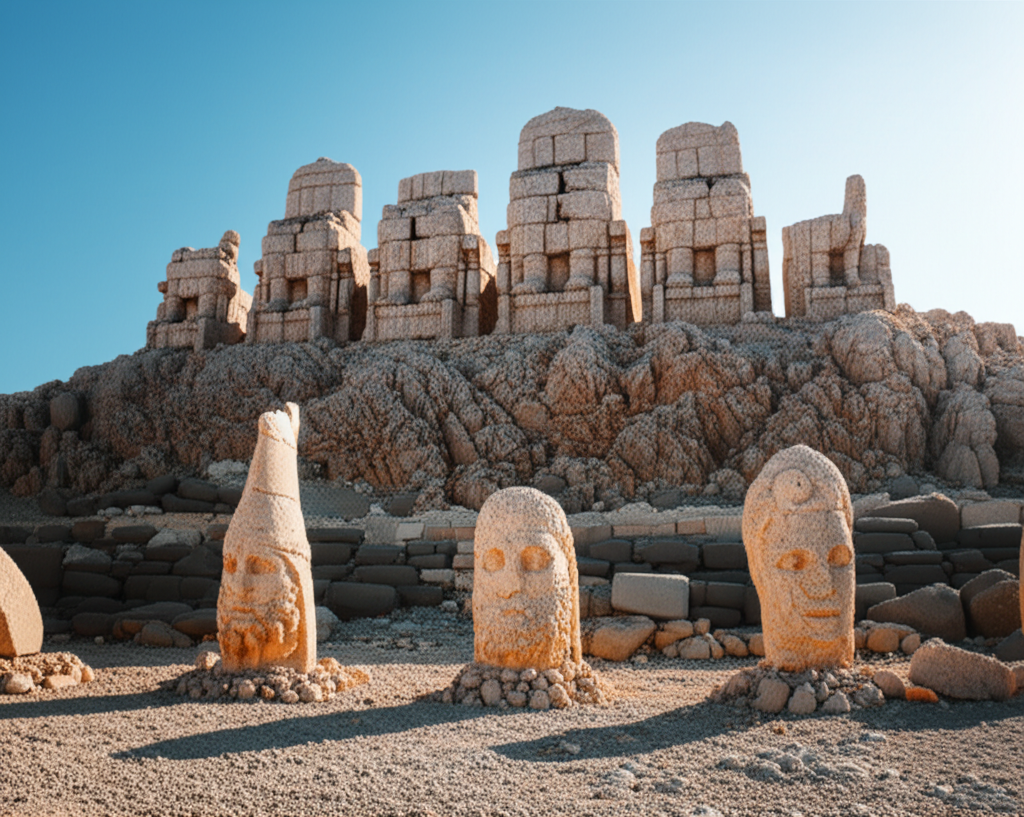
The Kingdom of Commagene, situated at a strategic crossroads between empires, represented a masterful exercise in political and cultural balancing. Under the astute leadership of Antiochus I Theos, this small Hellenistic kingdom skillfully navigated the perilous divide between the expanding Roman Republic to the west and the formidable Parthian Empire to the east. The monumental sanctuary at Mount Nemrut stands as the ultimate physical manifestation of this sophisticated diplomatic and cultural strategy. It was conceived not merely as a royal tomb, but as a profound declaration of legitimacy and divine authority.
The arrangement of the colossal statues was a deliberate act of political theater. By placing figures from the Greek pantheon, such as Zeus, alongside their Persian counterparts like Ahura Mazda, and seating himself among them, Antiochus I engineered a new royal cult. This syncretic Greco-Persian religion was designed to unify his diverse populace and appeal to the cultural sensibilities of his powerful neighbors. The monument projected an image of a ruler who drew his lineage and power from both the East and the West, thereby positioning himself as a unique and indispensable sovereign.
This theological fusion was a calculated effort to secure the kingdom’s autonomy. By creating a religious framework that was both familiar and distinct to Romans and Parthians, Antiochus I reinforced his dynasty’s divine right to rule an independent realm. The hierotheseion at Mount Nemrut, therefore, was far more than a monument to dynastic pride; it was the physical embodiment of a complex survival strategy, immortalizing a kingdom that thrived on cultural synthesis.