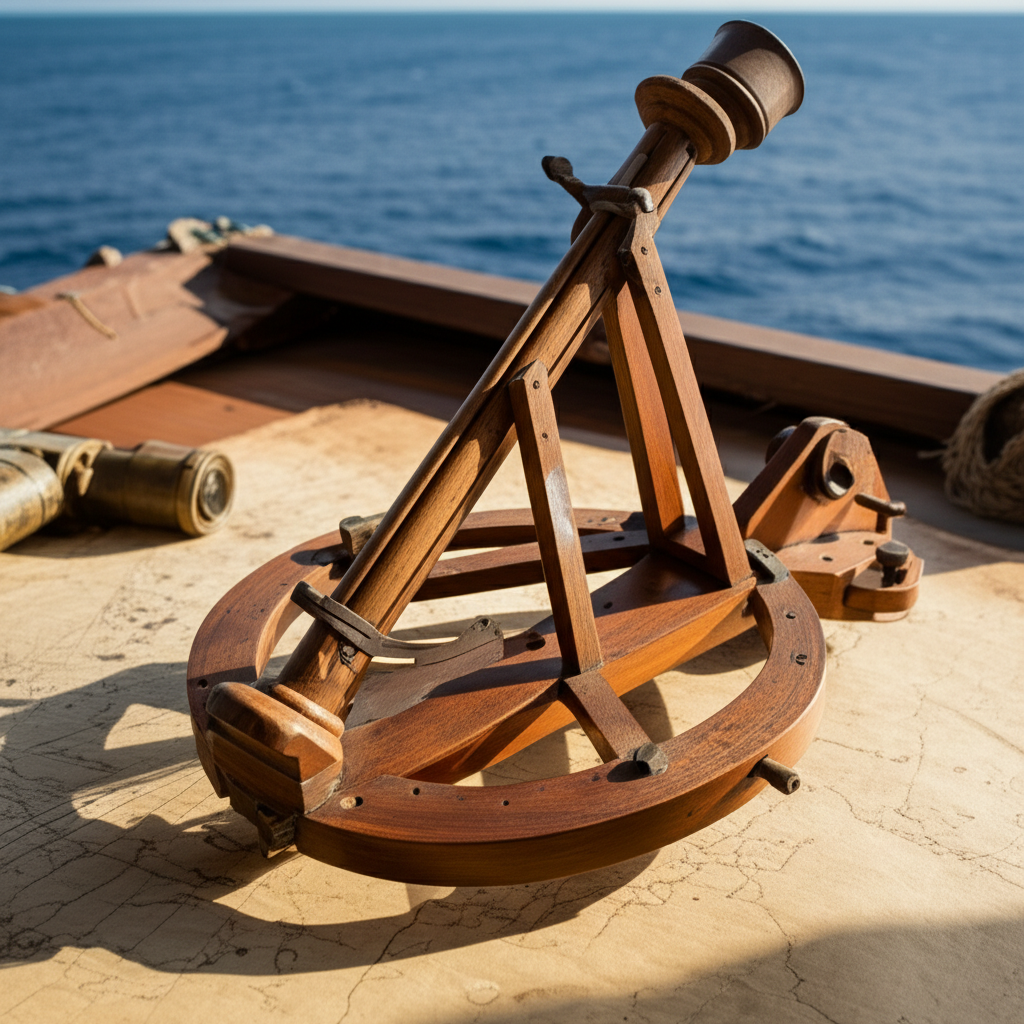
The backstaff represented a significant strategic advancement in celestial navigation during the late 16th and 17th centuries. Its development addressed the principal failing of its predecessor, the cross-staff, which required the mariner to stare directly into the sun to take a measurement. This older method was not only hazardous to the observer’s vision but also introduced considerable error, as the intense glare made precise alignment exceedingly difficult.
The genius of the backstaff, often called the Davis quadrant after its English inventor John Davis, was its inverted observational method. The navigator stood with his back toward the sun, aligning the instrument so that the shadow of an upper vane fell upon a horizon slit, through which the horizon itself was viewed. This arrangement eliminated solar glare entirely, permitting a far more accurate and comfortable reading of the sun’s altitude at its zenith.
By separating the solar observation from the horizon sighting, the backstaff allowed for a more stable and deliberate measurement. This optimization greatly improved the reliability of calculating latitude at sea, a crucial factor for long-distance voyages. While eventually superseded by the reflecting octant, the backstaff remained the paramount instrument for solar observation for over a century, marking a critical step toward precision in open-ocean navigation.