
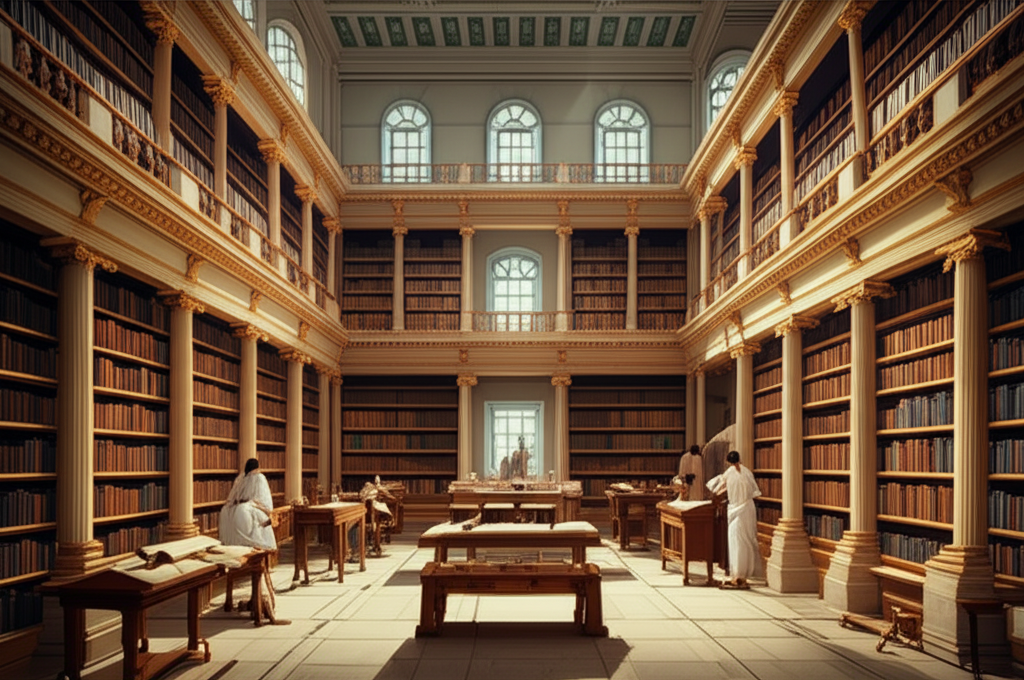
The Library of Alexandria was not a singular edifice but rather the intellectual heart of a larger research institution known as the Mouseion. Established under the Ptolemaic dynasty, its physical arrangement was intrinsically linked to its function as a center for scholarship, not merely a repository for scrolls. The organizational layout was conceived to support a community of resident scholars in their work.
Primary sources, though limited, describe a campus-like complex connected by covered walkways, or peripatoi. This central architectural feature linked essential spaces, including lecture halls, shared dining areas, observatories, and gardens. The vast collection of scrolls was not housed in one monumental hall, as is often imagined, but was likely stored in numerous rooms or smaller buildings attached to the main complex. This decentralized storage system facilitated access for scholars working in different disciplines within the Mouseion.
Efforts at a definitive reconstruction have been profoundly hampered by the scarcity of archaeological evidence. The ancient quarter of Alexandria lies beneath the modern city, leaving scholars to rely heavily on textual accounts from classical authors like Strabo. These descriptions, however, often provide a general sense of the institution’s grandeur without offering precise architectural details. Consequently, modern depictions of the Library’s layout are largely scholarly inferences, assembled from fragmented historical references rather than from excavated foundations.


