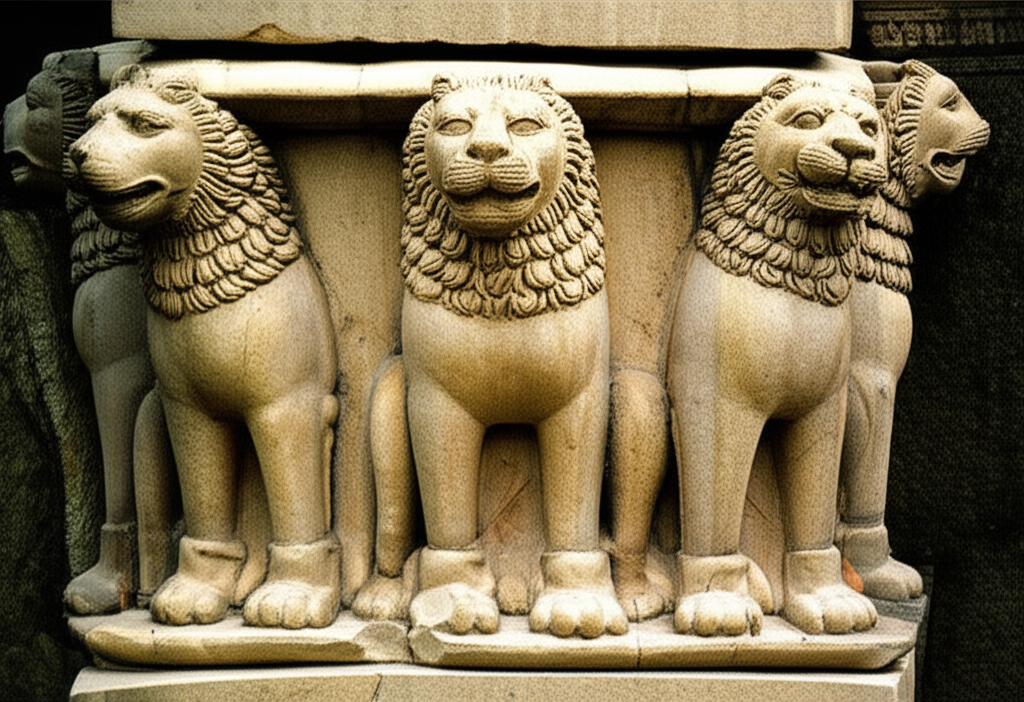
The Lion Capital of Ashoka, erected circa 250 BCE at Sarnath, was a sophisticated instrument of imperial policy, transcending its function as mere architectural decoration. Following the transformative Kalinga War, Emperor Ashoka pivoted his statecraft from military conquest to the propagation of Dharma. The capital served as a powerful visual manifestation of this new political ideology, strategically placed in the location of the Buddha’s first sermon.
The four Asiatic lions, projecting authority in the cardinal directions, symbolized the universal reach of both the Mauryan Empire and the Buddhist doctrine it now championed. This imagery was a calculated fusion of power and principle. Below, the abacus features the Dharmachakra, or “Wheel of Law,” underscoring the shift towards righteous governance. The presence of the bull, horse, elephant, and lion in motion around the wheel represented the temporal world subject to this moral law. Placed atop monolithic pillars, these capitals functioned as broadcast points for the emperor’s vision of a unified, ethical state.
The subsequent adoption of the Lion Capital as the National Emblem of India in 1950 illustrates the symbol’s remarkable endurance. The modern republic recontextualized its message, harnessing the ancient ideals of universal law and peaceful strength for a new democratic era. This act affirmed the capital’s legacy not just as a Mauryan artifact, but as a foundational symbol in the long narrative of Indian history.