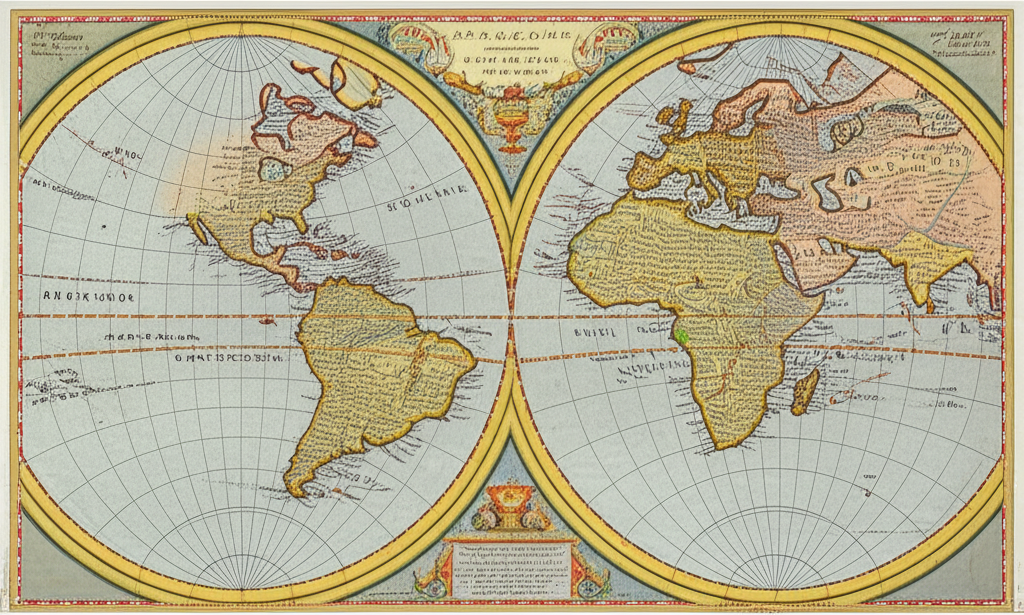
The Treaty of Tordesillas, signed in 1494, represented a critical diplomatic maneuver by the Iberian powers to codify their dominion over newly discovered lands. Sanctioned by the Papacy, this agreement was far more than a simple act of cartography; it was a calculated attempt by Spain and Portugal to preemptively resolve colonial disputes and establish an orderly partition of the globe. The treaty revised an earlier papal bull, shifting the Line of Demarcation approximately 370 leagues west of the Cape Verde islands.
This westward adjustment was a strategic victory for Portugal. Possessing more advanced knowledge of Atlantic currents and coastlines, Portuguese negotiators likely suspected the existence of landmass to the east of the new line. This foresight secured their claim to what would become Brazil, a territory that proved immensely valuable. For a time, the treaty successfully mitigated direct conflict between the two Catholic monarchies, allowing each to focus its resources on consolidating its respective sphere of influence without fear of immediate Iberian interference.
However, the treaty’s authority was fundamentally limited. It was an agreement predicated on the notion that only two European powers had a legitimate claim to the non-Christian world, a premise swiftly rejected by emerging maritime nations. England, France, and the Netherlands disregarded its terms, viewing the papal decree as an irrelevant arrangement between rivals. Ultimately, the Treaty of Tordesillas served not as a permanent global settlement but as a temporary framework that governed the initial, explosive phase of Iberian expansion before succumbing to the pressures of broader European competition.