
On the morning of September 1, 1859, the British astronomer Richard Carrington observed a blindingly white flash within a cluster of sunspots. While the scientific community had previously noted solar irregularities, the subsequent geomagnetic storm marked a definitive turning point in the understanding of solar-terrestrial physics. Within hours, a massive Coronal Mass Ejection struck the Earth’s magnetosphere, igniting auroras so brilliant that gold miners in the Rocky Mountains awoke to prepare breakfast, mistakenly believing the day had dawned.
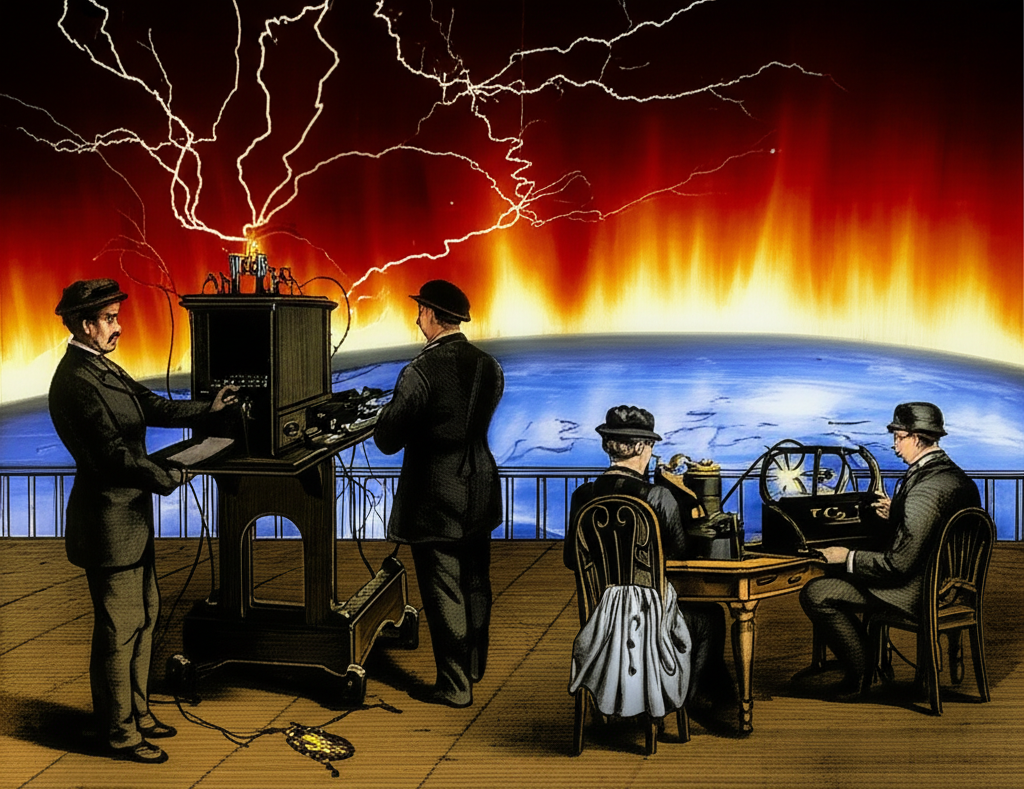
The true severity of the event, however, manifested within the world’s burgeoning telecommunications infrastructure. The Global Telegraph Network, then the pinnacle of Victorian technology, effectively acted as a colossal antenna for the geomagnetically induced currents. Across Europe and North America, the influx of atmospheric electricity overwhelmed the primitive grounding systems. Telegraph pylons threw sparks, and platinum wires melted under the intense surge, igniting papers and causing fires in station offices.
In a remarkable display of the storm’s power, telegraph operators in Boston and Portland managed to disconnect their battery banks entirely. For nearly two hours, they successfully transmitted commercial messages solely using the Auroral Current surging through the lines. This phenomenon demonstrated that the induced electrical load was not merely a disruptive noise but a potent, consistent power source capable of driving machinery.
This catastrophe highlighted a critical vulnerability in the reliance on wired communication. The event proved that solar activity possessed the capacity to dismantle earthly industry on a global scale. Even in 1859, the collapse served as a stark lesson on the fragility of human engineering against the violent mechanics of the solar system.


